Happy New Year Literacy Land friends!! I am so excited to have been a part of this team for the last year. This is my first post of 2015 but we are going to reflect back to 2014!
My first post last year was about how we (my teammate and I) implemented the reading salad outlined in Comprehension Connections by Tanny McGregor. We found that it had a lasting impact to our year and we really wanted to do the lesson again with our firsties this year. So we did.
We followed the different activities that Tanny McGregor has laid out in her book, including the reading salad, metacognition poster, and thinking stems. But we made just a few changes to our instruction this year.
First of all, we decided to use the Otis books by Loren Long for all the metacognition lessons.
We found that these books are perfect for the lessons that we had outlined for the week because the stories follow a predictable pattern. Otis has a friend that runs into a problem and Otis makes the choice to solve the problem. The problems are hard to solve and you discover that Otis is brave, kind, caring, and an amazing friend to all. This leads to some great connections, insightful thinking, fantastic conversations, and an ABSOLUTE love for the books.
We also decided to add more deep thinking to our reading salad. Deeper thinking does not come easy to all of our little firsties. But I wanted to make it as concrete and successful as our reading salad lessons have been. Then...it came to me!
My writing teammate and I use paint chips to teach adjectives and the "shades of meaning." Our students really seem to understand that the deeper the color of paint chip, the richer the word is. I decided that this would also work of thinking. The deeper the color, the deeper the thinking.
I decided to start with making deeper connections because I found this to be a weakness during our DRA testing. The firsties made many, many personal connections but not as many text to text or within text connections. I created a poster that looked like this.
I modeled what this poster meant and how to use it by referring to the previous Otis books that we had read. As I read a new Otis text, students shared their thinking to make a reading salad. If a deeper connection was made, students got to put in a deeper, darker thinking strip.
By the end of the text, our salad was overflowing with deep connections and thinking.
To practice deep thinking the next day, we read another Otis book but used this poster:
Now that we have built a strong, concrete foundation for metacognition and deeper thinking, our students will know how to refer back to these posters and resources.
If you would like to use these posters in your classroom, you can download these sheets by clicking on the image below:
I hope these can help your students deepen their thinking, as well! Happy thinking!
Word Study Made New Again: Routines and Procedures for Phonics Study
In the fall of 2005 I transferred to a school that was one year into Word Study training, so that year was a trial by fire. I learned the basics of the assessing, grouping, instructing, sorting, and assessing. The routines were set and the cycle continued. I felt pretty good about what I was doing.
As the years past, I added and deleted activities and routines as I thought I should. I’ve taken classes here and there and was comfortable. This summer I decided I needed to take an “official” class to update what I know. I also wanted some credibility with the staff at my new school. If I’m the one doing training, I wanted them to have confidence in me.
Feeling pretty good about myself and thinking I’d just sit back and take the class, I found myself taking page after page of notes. All of the information wasn’t new, but some was a new way of thinking. I did have an earth-shattering (almost) a-ha. I'll post it at the end...stay tuned. I was excited about word study all over again. Here are some of my notes.
Meaningful Introductions and Sorting
It is important to make sure students are given explicit and meaningful introductions to the sort. Each word in the sort should be described and discussed carefully. The headers should be used, not only, as the title of the column, but as a point of reference for the generalization. Each picture or word should be matched to the header. As the words are added to the columns, they are described as to why they belong in the column. It’s not enough to say, “camp belongs on this column because it ends like stump.” We need to make sure students are using the words to explain the generalization EACH time. “The picture “lip” belongs in the “ip” column because I hear a short i in “lip.” Students need to be able to explain the generalization as they sort.
Meaningful Guided Practice
The practice activities MUST enhance the feature. If they don’t, don’t do it! Word triangles, pyramids, or steps don’t teach the feature. They don’t explain the generalization. Create meaningful ways to practice the sorting.
1. Labeling the sort cards is a valuable experience. Students need to see the cvc, cvcc, or cvce codes when they sort, so the generalization is more concrete. When students need to add endings to words, learning that most cvc words double the final consonant before adding the ending students will be able to spot a cvc word without much effort. Labeling is a stair-step skill.
2. Word Hunts - Another meaningful practice is the word hunt. Students can use their independent books, words in the room, or poetry folder to find words that match the feature they are studying. If their feature is a short a sort, finding short a words in their environment is important to making connections. As they find words, they should label with cvc. When they share their word hunts, students should be asked to explain the generalization to prove their case. Word Hunts are more effective if they are discussed and not just checked.
3. Speed Sorts - A new take on an old favorite would be: Speed Sorts. That’s right, speed sorts. Nothing new, right? Wrong. Students should not be racing against each other. It puts the emphasis on the contest, not on the generalization. The new-and-improved speed sort asks students to race against themselves. It’s still a partner sort…one person has the timer, while one person sorts against it. Each race is recorded for speed and each person races against their own speed. (This can also be a great homework lesson with mom’s cell phone timer.)
Meaningful Centers and Homework
Centers and Homework are areas where word study needs to be updated. Teachers have fallen into a rut of sorts. Monday – write your words. Tuesday – triangle words (UGH). Wednesday – rainbow words (double UGH). Thursday – practice test. Don’t forget the new rule: If it doesn’t ENHANCE the feature, don’t do it! This also applies to homework. Without using, “It’s easier on the parents” or “But the parents don’t know what to do” as an excuse…it’s about the student and it’s about the feature. There are great ways to practice the sorts that can enhance the feature.
1. Magic Criss Cross are a great way to show the similar short vowel feature. Students fill in the magic boxes with crossing vowels. Vowels can be written with marker and pictures can be illustrated to show meaning.
2. SAW – After Feature A students can use the SAW to practice. Students SORT, ALPHABETIZE, AND WRITE. Students should sort their cards. Alphabetize each column individually. Then, write the columns alphabetically. Highlighting the features of the words in each list is mandatory.
3. Sentence Triple Threat – This is not the usual “Write a sentence” activity. This activity requires students divide their list into thirds and write three types of sentences. One-third of the words need to be written as a declarative sentence. One-third of the words need to be written as a question. One-third of the words need to be written as an exclamatory sentence. Students should make sure to highlight the feature.
Meaningful Assessments
Of course, assessments are crucial. We have to know what the students know and what they don’t know to be able to move them forward. One of the biggest shifts in thinking is the difference between teaching in learning. Teachers need to know if the students understand the features and are able to transfer their understanding to their own writing. Frustrated teachers will come to me saying, “They know it on the test, but they aren’t using it in their writing.” Well, I take a deep breath and ask, “If they aren’t using it they don’t know it.” The teachers need to make the distinction between what they have “taught” and what the students have learned. One way to make sure the students are applying their knowledge is to have one word that demonstrates the feature on the test that the students have not practiced. The easiest way to do this is by cutting off the bottom row on the sort and saving it for the test. With good practice and homework, students should be able to recognize the feature and sort it appropriately on the test. Another shift in thinking is about the score the students get on a test. Students should always get a 100% (or very close) on the test.) If they don’t, they don’t know it and they haven’t generalized it. Sooooo…Do it again. Yep, do the same generalization with different words. If everyone in the group makes a 100% except one child, then that child will need a review and a retest while the group moves on. The bottom line is: it doesn’t matter what you teach…it only matters what they learn.
By the way, here's my EARTH-SHATTERING change in thinking.
Yep, I was in the awful habit of interchanging the terms "word study" and "spelling." I am so so glad I took that class last summer...and I'm not afraid to say it.
By the way, here's my EARTH-SHATTERING change in thinking.
Yep, I was in the awful habit of interchanging the terms "word study" and "spelling." I am so so glad I took that class last summer...and I'm not afraid to say it.
I hope you have something new to try in your word study. If you do, let me know how it works.
Click here if you’d like a Classwork/Homework Idea Sheet.
Click here if you'd like a Magic Criss Cross sample, click the link.
An Easy Fluency Fix
Hello to everyone! It's Andrea from Reading Toward the Stars with an idea for helping with fluency in your classroom.
I have been working with my third graders to help them read with fluency. They love to ramble through words or read soooo s-l-o-w-l-y that anyone that would fall asleep. Each week we work on a new passage and different strategy to help with their fluency. Several weeks ago, we worked on using punctuation to help build our fluency.
After reading the passage several times, we talked about how to read it, so it would be understood more clearly. I read it with NO punctuation, and they laughed at me. I made lots of mistakes and sounded awful. I then read it as it was supposed to be read, and they "got it".
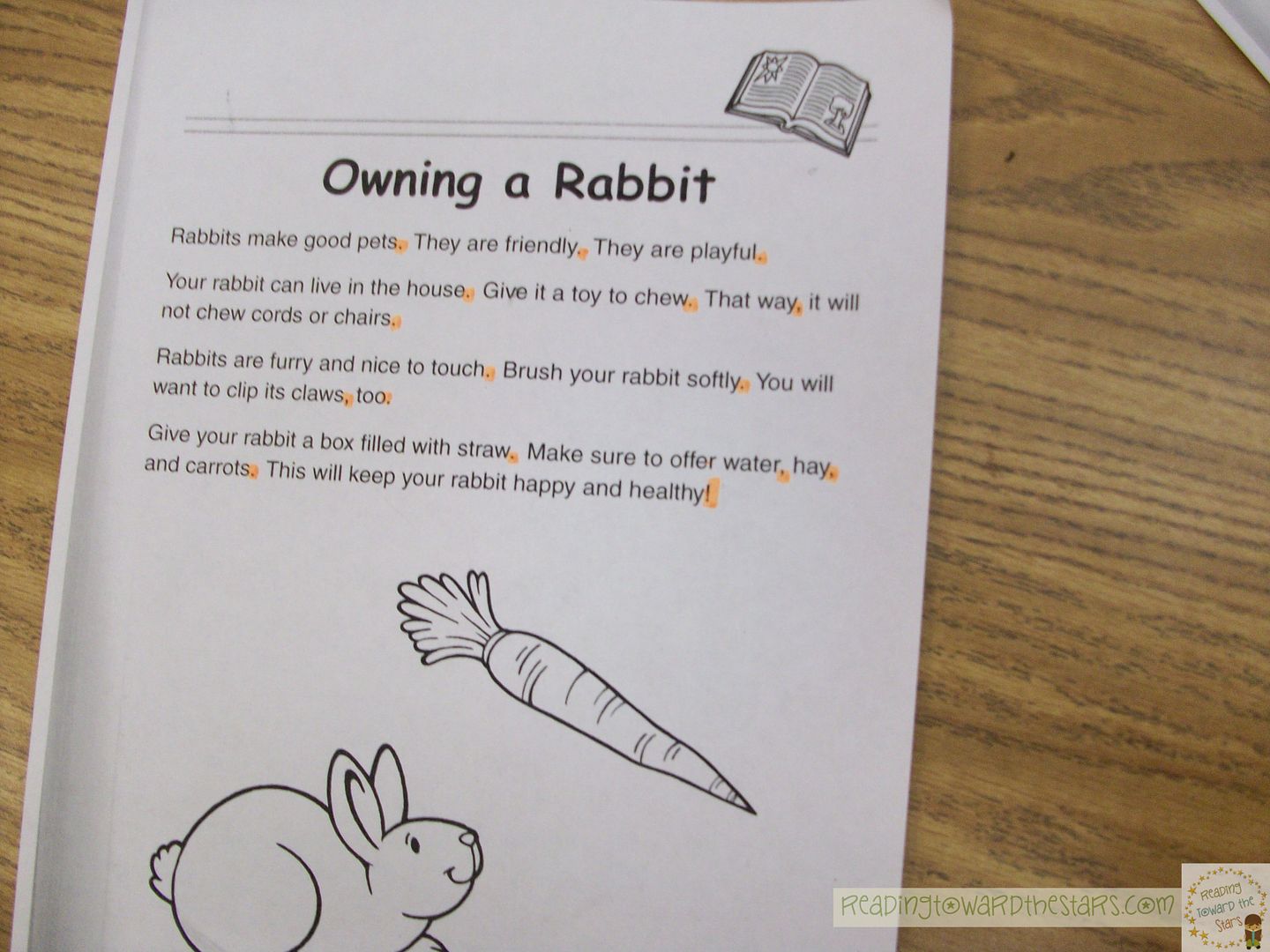
We talked about the punctuation in the passage, and they highlighted all of the punctuation. Then when they read it, they read it with better fluency, pausing as needed to make it sound right.
Using punctuation is an important factor in fluency. Students need it to help with prosody and inflection. It helps to make sense of what they are reading and leads to better comprehension.
What are some ways you help your students attend to punctuation when reading?
I have been working with my third graders to help them read with fluency. They love to ramble through words or read soooo s-l-o-w-l-y that anyone that would fall asleep. Each week we work on a new passage and different strategy to help with their fluency. Several weeks ago, we worked on using punctuation to help build our fluency.
After reading the passage several times, we talked about how to read it, so it would be understood more clearly. I read it with NO punctuation, and they laughed at me. I made lots of mistakes and sounded awful. I then read it as it was supposed to be read, and they "got it".
We talked about the punctuation in the passage, and they highlighted all of the punctuation. Then when they read it, they read it with better fluency, pausing as needed to make it sound right.
Using punctuation is an important factor in fluency. Students need it to help with prosody and inflection. It helps to make sense of what they are reading and leads to better comprehension.
What are some ways you help your students attend to punctuation when reading?
Have you Fallen in Love with Close Reading?
Hello Lit Land Readers! I hope you're enjoying a happy Sunday, but if you're like me, you are most likely chained to your laptop today to fine tune your plans for the week. I'm here today from my home blog, Comprehension Connection, to gather and share my thoughts on Close Reading. In a few weeks, I am presenting a workshop for the staff at my school, so putting together this blog post will hopefully help me narrow down the important points I need to and want to share.
Last spring, Chris Lehman, author of the book, Falling in Love with Close Reading, presented at the Virginia State Reading Association conference which I attended. At the time, Close Reading was certainly becoming the rage in reading instruction, and although I'd read blog posts and purchased materials to use with my students, I wanted to know more. Of course, I left with his book and a clearer picture of what I needed to do and how.
First Reading-Lenses
Ø Briefly assess schema for the text.
Ø Set the purpose for the reading lesson. Tell your students the text evidence they are to record.
Ø Keep each student actively engaged with the text by questioning their thinking. Flush out confusions and help the student clarify the meaning.
Ø Allow time for discussion and debriefing about the reading afterwards. Students need to share their observations and respond to each other.
Second Reading-Patterns
Ø Review previous observations briefly.Ø Set a new purpose for the reading lesson. During the second reading, students begin to rank the importance of text information and observe how ideas are connected.
Ø Read and record new evidence to match the purpose. (and improve reading fluency).
Ø After reading is completed, the response is the best assessment of understanding. Students need to independently record their thinking and share it for clarification.
Third Reading-Ideas
ØSet a new purpose for the reading lesson. During the last reading, students use high level thinking skills and observation to analyze the ideas shared.ØReread all or part of the text to gather ideas.
ØAfter reading is completed, students respond with their learning via a written prompt or through discuss about their learning.
Lesson ExampleI am sharing a sample lesson today with this post to show how I work with my students with a Close Read. To begin, I use a before/during/after approach with every lesson, and Close Reading is no exception. I build schema for the reading with my students typically with an organizer, anchor chart, or response form of some sort and a key question for them. For this lesson, I plan to begin with a Penguins Tree Map for brainstorming prior knowledge followed by our first read. During the first read, students are asked to find penguin characteristics.
On day 2, we will read to respond to the Four Squaring Thinking organizer.
On the final day, students may reread the full article, but with the final day, the focus is using the information gathered to develop a writing plan that uses the information. Students will explain how they'd use the information to protect endangered penguins.
To download the Close Reading set I made, just click the collage below, and remember, throughout the process to talk less and observe your students' thinking.
Have a wonderful Sunday, and now...I'm off to get my own plans done. Until next time..
Subscribe to:
Comments (Atom)