Center Survival! Three Keys to Success during Independent Centers

Center Survival! Three Keys to Success during Independent Centers

1.  What is your favorite time of the day?
2.  What is the most crucial time of the day for independent learning?
3.  What is the easiest part of your weekly lesson plans?
4.  What needs to be based on routine, routine, routine?

OK...by now you know the answer to all of these should be center time.  If it isn't, I hope to convince you to change your mind about centers.  If it is, I hope I can give you at least one new idea to think about and maybe even implement.

I cannot emphasize enough the key to centers is routine. From Day 1.  No excuses.

Set-Up and Classroom Management

This is so very important...your room has to lend itself to independence.  The more independence your child has, the better centers will be.  The set-up of your room and materials cannot be overlooked.  When teachers and I work together to make centers work in their rooms, we make sure center areas are clear.  Each center has a table or group of desks and a designated shelf.  To make sure everyone knows about the center areas, signs are hung from the ceiling.  These signs are universal in the room, as they will be on the shelves, the bucket for materials, and the center board for self-directed centers.  Students know where to get and return materials and where the center rotation takes them.

Center Expectations

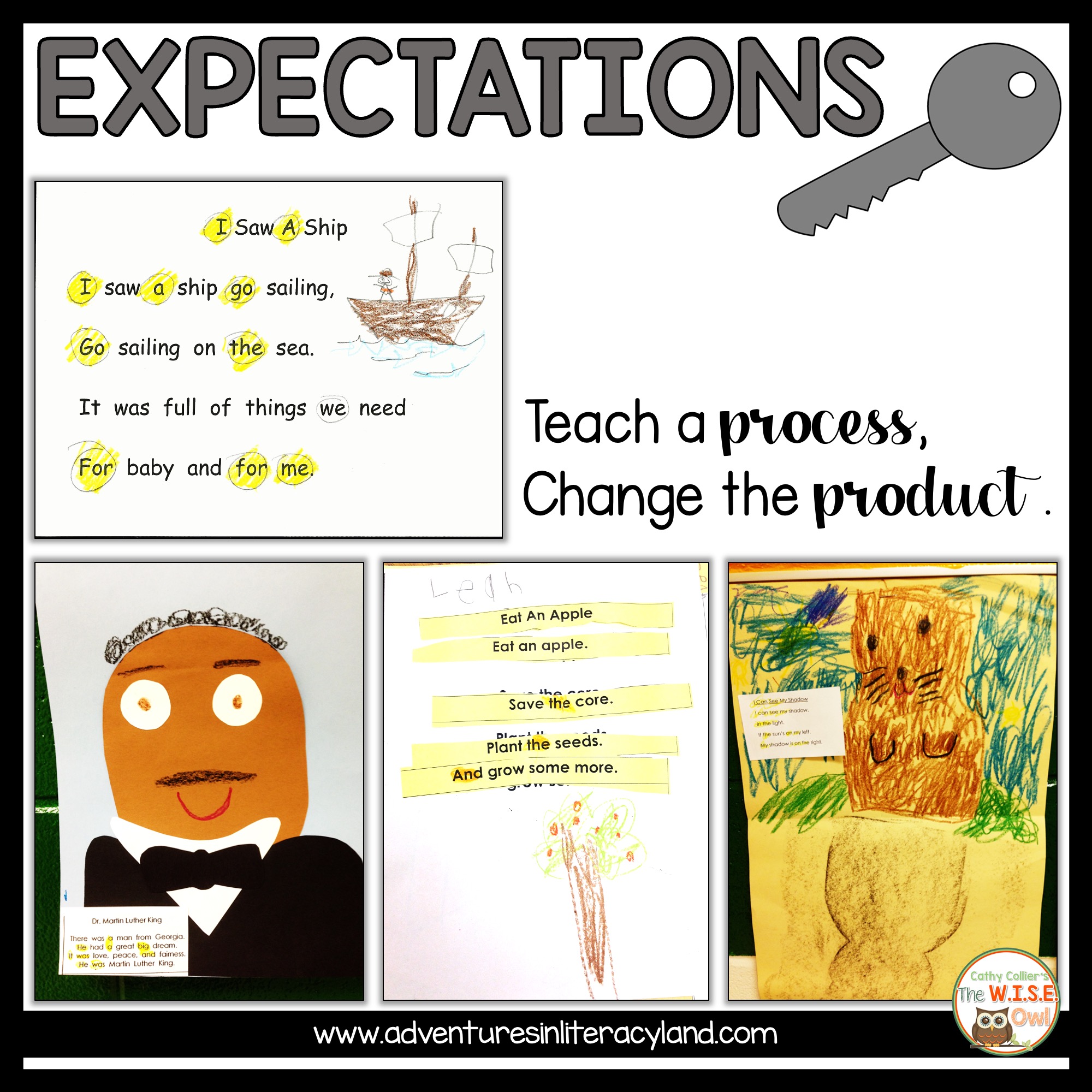
Expectations are key.  Students must need to know what is expected or they can't give it to you.  It's that simple.  Centers are NEVER the new skills.  If you want centers to be independent, they must be review skills.  If your lessons are the "I do, we do, you do" method...centers is without a doubt the "you do."  The best method for keeping sanity in the room and sanity in your plans:  CHANGE THE PRODUCT, NOT THE PROCESS.  If the ABC center is practicing rhymes, let them do it for several weeks in a row.  Change the rhymes, but let the exercise for rhymes be the same.  If the word wall word center is a "Read It, Write It" sheet, change the words on the paper, but the process is the same. My poetry center is always the same...just a different poem.  OH, and I forgot to mention, my poetry center and art center are ALWAYS the shared reading poem from the week before. They know it, they don't need help.

Center Self-Monitoring

Finally, students must be taught to self-monitor.  Part of this goes hand-in-hand with expectations.  Students will know what to do...you've covered that!  Students will know how to do it...you've covered that.  The last thing you need to do is let them know what to do when they are done. If you have a teacher assistant, students should be taught to raise their hands and get their work checked.  The TA will look over the work, decide if it's done, then tell them to "stamp it and put it away."  That's right.  Let them stamp their paper and let them file it.  They can do...it's part of their job.  If the student did not complete the assignment or if something needs to be fixed, the TA should ask them to check the example and fix the problem.  Don't get in the habit of telling them how to fix it, they need to do it.  If you don't have a TA during that time, then an additional step must be added.  Students should know to "get a book" or add a "fill activity" (something familiar to fill the time until you are done with a reading group).  You pull a reading group while they work.  When you are done with the group, you rotate and check and move to the next group as they move to the next center.

I could go on and on.  I can talk centers all day...but that's a good start.  Routine is the key!


Writing Letters in 2nd!

Hello! It's Tara from Looney's Literacy again! I'm so happy to be back and sharing how we've been practicing writing letters in second grade.

In this digital age, friendly letter writing is slowly becoming a lost art. I know that e-mails, texts and instant messaging have replaced most of my own letter writing. This kind of makes me sad. I think it's important to have this skill. Even if it is becoming obsolete it is still a form of writing that  kids should know. When I teach writing of any kind I always include mentor texts. This is important in stressing that reading and writing are reciprocal.  Some fun mentor texts for letter writing include:

The Jolly Postman or Other People's Letters is a sweet story of a postman who delivers mail to some very familiar storybook characters. Every other page is an envelope that contains each letter he delivers.  This is perfect for teaching different purposes for letter writing and how to address an envelope. 

Dear Mr. Blueberry is a great way one to share about friendly letters! Emily is very eager to share that she has a whale, in the pond in her yard,  with her teacher. Mr. Blueberry responds to her letters and lets her know that this is not possible but Emily continues to insist that there is until the end. 

Punctuation Takes a Vacation has several great opportunities to learn new things. It has a fun way of learning how punctuation works and gives examples of how postcards work. It's a win-win! 
With Valentine's Day right around the corner it's the perfect time to practice letter writing! 
I've put together this little treat to make your Valentine's Day sweet!

Hello everyone! It's me Tara from over at Looney's Literacy and I'm going to share a very exciting discovery I've made this year.
This year I decided to study formative assessment plans  and the use of said plans to help students create and meet learning goals. Thus began my journey of studying and practicing formative assessment plans to help my students create and meet learning goals. The nature of the literacy interventionist is to adjust teaching to meet learners' needs. That's just what we do. However, I wasn't consciously using the information gained to share with my little learners. I was telling them my analysis, and showing them how to do it my way. I never really discussed their learning with them. Until now! I've seen the most growth with my ELL student who didn't want to speak English and told me daily "I know no how to speak English." Today he told me, "Verbs are things that you do. "  I have to admit I got a little teary eyed. He has absolutely blown me away with his progress!  He is now reading and showing his understanding by writing down the answers to the questions. We've progressed from answering orally in short phrases to answering orally in almost correct, complete sentences.  Last week he started writing down the answers in his ELA notebook!
So...How did he get here? It all started with The Formative Assessment Plan by Nancy Frey and Douglas Fischer. This book basically laid out the formative assessment process. This process that utilizes the gradual release of responsibility.  You can read more about my learning from this text  here.
I started by analyzing his summative data. Taking the fact that English is his second language, I wanted to break it down and start with our alphabetic code. By doing this I found while he knew all the letters of our alphabet he does have some visual  confusions, such as b/d. Plus it was a good review of individual sounds, digraphs, and consonant blends.   I also know that some letters don't have the same  sound in Spanish so I still scaffold when he encounters words with these letters. After I knew where he was I talked to him about the reading process.   I helped him find his strengths and weaknesses and then he was able to set goals. We create weekly checklists so he can revisit  goals any time he needs to. Here's some examples of some checklists we've created:
          I use formative information in all of his lessons with me so I can adjust my teaching to where he's at.When I'm creating lessons I like to pre-plan the process so I'm prepared for any direction it may go. Here is an example and FREEBIE of a lesson we like to do in the winter.


What is Wilson? An Overview by Reading and Writing Redhead


Hey everyone, it's Bex here from Reading and Writing Redhead! I'm stopping by to share some info with you about Wilson and the Wilson Language programs!


Have you heard of Wilson but are not sure what it is? Have you heard of other schools that have Wilson certified reading specialists, a school is hiring but wants someone with Wilson certification, or your child's school offers Wilson intervention but  you are not clear on what it is? Or do you just want a refresher on Wilson? Well, this update is for you! I know when I was a newer teacher I kept hearing that Wilson, OG (Orton-Gillingham), or LiPS would be possible interventions for some of my students who were struggling with reading, but I did not know what those were, so I figured a little summary of what I now know might help someone.

The Wilson Language Institute was found by Barbara Wilson, who was a  special education teacher and tutor. She developed it while she was working at Mass General Hospital's Language Disorder Unit in order to teach students the structure of words in a systematic and cumulative manner so that they can gain the confidence that they will be able to become skilled readers. After Wilson became successful, the focus turned to training educators so they could implement Wilson in their own schools.
Wilson offers several programs. The most intensive is the research-based Wilson Reading System (WRS), which is most often used to support students with learning disabilities, and it's recommended that educators spend 60-90 minutes working with students in small groups (6 or less) every day. It is based on the principles of Orton-Gillingham. WRS directly teaches the structure of the language for decoding and encoding and also addresses fluency and comprehension.  It also has multisensory aspects and has been used successfully to help both children and adults master English. WRS has 2 levels of vocabulary that makes it appropriate for younger students as well as older students and adults.

Wilson emphasizes that it is essential for schools to have trained and certified teachers to implement the system, and they offer training at their headquarters in Oxford, MA, as well as around the countries. Many school districts hire Wilson to come and train their entire staff or their reading teachers. Click here to see an overview of the multi-tiered system of support that the Wilson Reading System offers.

Wilson collected data for more than ten years from school districts that were experiencing success using WRS. This led to the creation of Fundations®, a research-based program that brings instruction to general education classrooms, so that the Wilson philosophy can be brought to all students K-3. Fundations® instruction is explicit, cumulative, systematic and multi-sensory.

Wilson also has a program for older students (grade 4 and up and adults) who do not need intensive intervention but have reading difficulties. The program is Just Words®, and it provides explicit decoding and spelling instruction. Just Words "accelerates the delivery of the Wilson Reading System®" in a way that is appropriate for older students and it is popular as a second tier intervention in schools or a program for adult learning centers. 

Finally, there is a program called Wilson Fluency/Basic® which provides supplemental explicit fluency instruction and reading practice. This allows students to practice applying skills with connected text. It is aligned with the other Wilson programs and provides practice with 200-250 word passages for students to improve their fluency.


I was lucky enough to be able to participate in the 3 day Wilson introductory training a few years ago and was hooked. It was introductory training for WRS. We went through sample lessons, acting as students, and learned how to set up our own lessons and plan (although most of the plans are pretty much done for you, there are ways to individualize it to your students' needs so you do have to do a small amount of prep). 

My  favorite aspect of WRS was the use of the magnetic letter boards. Daily practice making words and reviewing the sounds and phonics and spelling rules that have already been taught make perfect sense. Plus, one of the weaknesses of so many students is encoding. Some other informal or teacher made (like some I made myself) interventions are focused on decoding and don't offer practice with encoding.

Last summer and fall I also went to Fundations® training. I loved the Wilson training, but since I am a general education teacher with a second grade class, it did not make sense to continue to try to pursue that certification. Fundations® is for teachers like me and intervention specialists who work in the classroom. It especially fits in great with RTI and can be used for all three tiers, in whatever way is needed. Fundations® does a lot with the magnetic letter boards, but also we drill sounds at the beginning of each lesson (a sound drill is reading the letter, a key word, and then the sound it makes and showing a card to the students, having them repeat it back). It is great practice and I feel it really helps the kids get that knowledge of the sound/spelling combinations. PLUS they LOVE it because after the first few weeks, the children get to be the drill leaders themselves! I have a puppet named Echo (that comes with the program) and the children hold the puppet and lead the drill, and the other students "echo" what Echo and the drill leader have just said. Fundations® also has  specific spelling practice and writing practice and also has a somewhat informal handwriting piece. There is also fluency work as well.


Personally, I have not been able to fully implement Fundations® because my school is tied to the old Treasures program and I have to spend time each day on that, and I still need to teach all the grammar and mechanics that is required in second grade. Additionally I bought materials myself so I only have enough for groups of 5 students, so I ended up doing Fundations® lessons during RTI tier one with my reading groups. However, I feel like these students are really doing well with it and I am assessing them throughout the year and looking to compare our DIBELS data to data from last year before I implemented Fundations®.

What reading intervention programs are you familiar with? Which ones have you used and what do you think works best? 

Emily, The OG Tutor, has some great blog posts relating to Orton Gillingham. Check them out here:

You can find more topics under the heading "Intervention" on our Topics page. Click here to see that page.