Breaking Down Skills

One of the most amazing (but also challenging) things about our career as educators is change.

We grow from the yearly changes that we encounter.  And the biggest change we confront each year: a new set of students.  This new set of little individuals bring their own strengths, expertise, and challenges to the classroom.  Because no two years look exactly the same, we must grow and change as educators in order to meet the ever-changing needs of our students.

After leaving the classroom to become a Title I teacher, I feel that I had to adjust quickly to the intervention demands my students required. I was overwhelmed by my desire to help them become readers but felt that my knowledge base needed to grow and expand.  I didn't seem to have just the right tools in my toolbox for each kid.  And so I had to grow as an educator.  I had to learn, try, and analyze my results.  What I found out was that I became a much better and must stronger teacher.


Currently as a push-in Title I teacher, I am constantly working with my team to analyze student data, make changes, and produce educational plans.  My daily schedule incorporates Tier I guided reading instruction, Tier II intervention on specific skills, guided math instruction, writer's workshop, and more Tier II interventions.  We look at the data and change groups when new needs arise.

Through all my research, trial and error, and personal learning, I found out that my expertise lies in breaking down skills for students.  Helping them to understand the real life connection, while also making it more concrete.  My teaching was not always this way.  But through the literacy writing of Tanny McGregor and the math instruction of Donna Boucher, I have found my own path and intervention techniques to help meet the ever-changing needs of my first graders.


As young learners, it can sometimes be hard for students to understand how the foundational skills connect to real world experiences.  I truly believe that helping our students make these connections will help them to achieve and grow as learners.

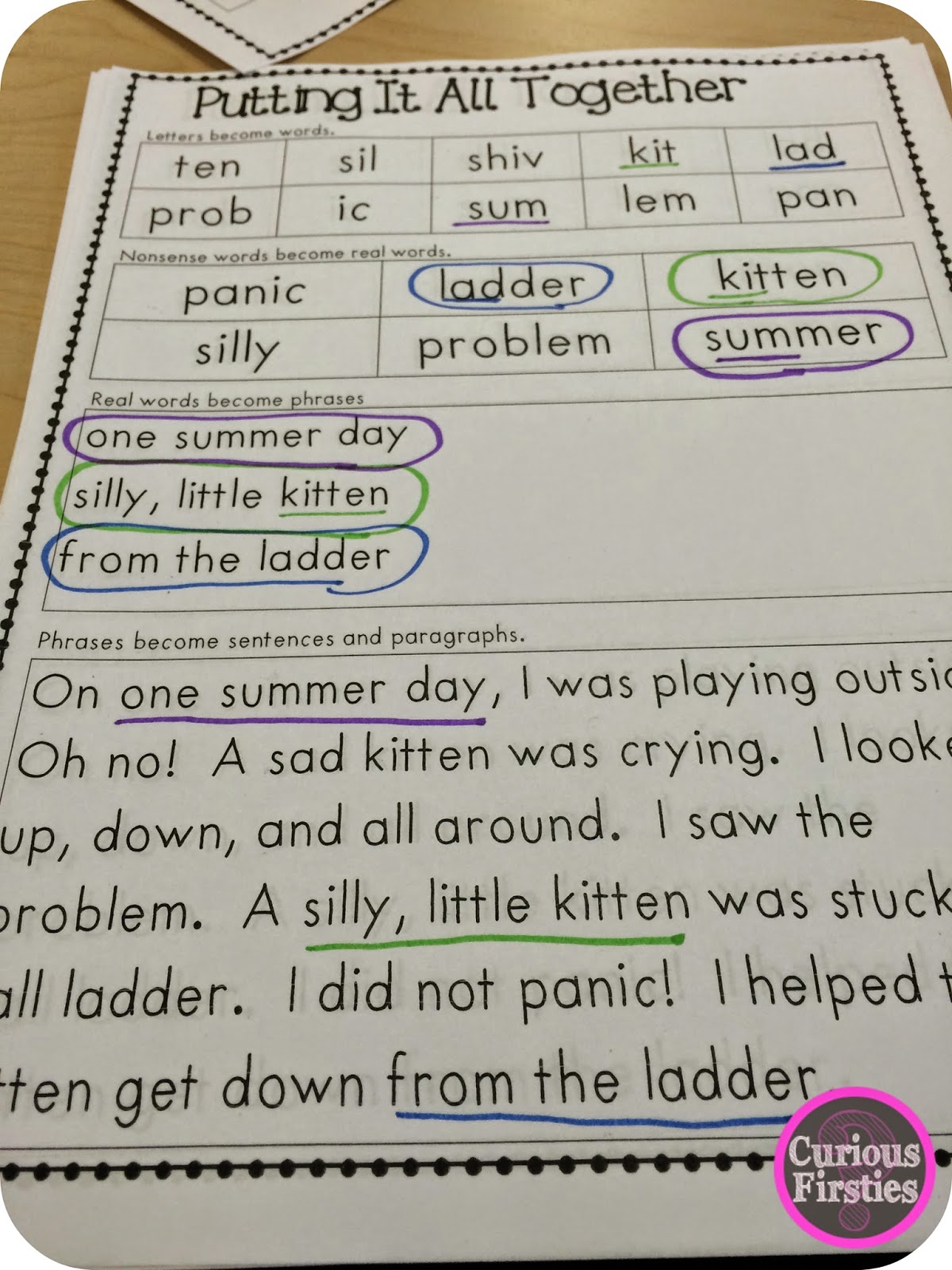
I like to take skills...break them down and then build them back up.  For example, decoding small words will help students to read 2-syllable words.

 Reading these words will help students when reading sentences or paragraphs.  To illustrate this, I created a simple sheet that does just that:

https://www.teacherspayteachers.com/Product/Letters-Words-Sentences-Putting-it-Together-1948469

I have found that my students get really excited to see that reading one small part of a word can help them to read an entire paragraph!

In other cases, I have worked with students that have a difficult time determining the difference between a letter, sound, and word.  Again, they needed to understand how those pieces come together to form the "big picture."  So along with manipulatives (letter tiles and word cards), I use an interactive powerpoint that helps them see how letters come together into words and the words come together to form sentences.  Here is an example of some slides:
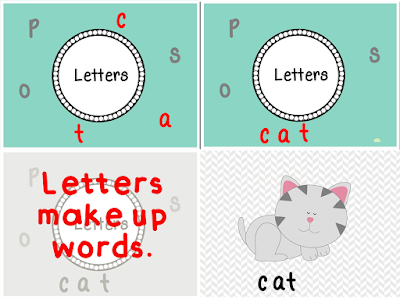
https://www.teacherspayteachers.com/Product/Letters-Words-and-Sentences-BUNDLE-796741

Whether it is comprehension, fluency, math skills, or phonics, I work hard to find ways to break down each skill for my students that need it. 

Trying out these lessons is always the best part!  I love to analyze, change, and re-create them for the years to come.

Two years ago, I was invited to contribute to Adventures in Literacy Land.  I was excited to learn new techniques, push my thinking, and incorporate ideas from other experts.  And what I have found from this experience is that my students have benefited from the variety of experts that write, comment, and read this blog.  Thank you helping me to guide my students as they grow as learners.



Happy 2nd Birthday, Literacy Land!


Can you believe that Literacy Land is officially 2 years old?

Me either!!  

This has been a fun ride, and I have made some good friends who have taught me so much about literacy and helping students learn.  I have really enjoyed sharing my passion for all things literacy with all of you, our readers.

In 2016, we plan to continue bringing you literacy ideas you can take straight to your classroom. 

So, join us all through January as we reacquaint you with our bloggers and introduce some new bloggers to Lit Land.  Make sure you stop by all month for tips, freebies, and a giveaway at the end!  You don't want to miss the fun!


Hello, everyone!  It's Andrea from Reading Toward the Stars.  

I love spending time working with my students to make it fun and engaging. Though I love all things literacy, my favorite aspect to work with is comprehension.  When I plan for comprehension activities, I like to find things that will make it concrete.  

Our school uses Thinking Maps to help students think about what they have read or will read.  This helps them to put their thoughts onto paper and make it all real.

Another way I make it concrete is by working through activities that make them move.  Students may put sticky notes on a chart and move them around.  They may make foldables to show what they are learning. 

 And we play games to make it real.  

More than anything, we have fun ~ tons of fun!  Students enjoy working with me and look forward to our time together.  The students don't even realize we are learning!  

Join us throughout 2016 as we bring you literacy tips, tricks, and timesavers!

Before you go, grab this freebie of summarizing templates that are perfect for making comprehension real!


And join us at the end of the month for a huge giveaway!  You won't want to miss it!


There's No Place Like HOME for Holiday Reading!


Greetings of the season my friends!

It's Jennifer from Stories and Songs in Second, stopping in during this busy holiday time to share good cheer and a unique type of reading celebration with you!  This post was written last December as the sun rose over Bonita Beach in southwest Florida.....a place that my own family has called "home" for the holidays for sixteen years.

Many of my siblings are wake up slowly each morning when we gather here, warming their hands around a mug of coffee or cocoa, with books open on their laps.  We were fortunate to be "raised as readers" by our Mom and Dad, and I am here today to share a creative way to help other teachers and parents encourage children to make time to honor and enjoy reading magic at home!

Today's idea was inspired by a very special Nordic picture book and an Icelandic tradition that I recently learned about!  I hope that you'll find that it is an easy one to adapt for use at home during the winter break, and then implement in your classroom afterwards!

Start a simple yet worthy holiday tradition in your home or classroom this December! Host an Iceland-inspired Book Flood and share the gift of reading with your students and family members!

Engaging Our Students At Home

My winter break has officially started.  Woot, woot!  How about you?  It is a magical couple of weeks off that are filled with family, friends, food, and fun.  It is exciting, somewhat relaxing, and eagerly awaited; however, there is also be a hint of anxiety.

Why, you may ask?

It is two weeks off for me...but also my students.  We have worked hard over the past few months and sometimes two weeks off can impact the upward swing or momentum of our learning.  This ties right back in to the posts that we wrote about Summer Reading by Richard Allington and the need to have reading routines in the homes of our students.  These routines can help to prevent any sliding backwards.

And really this is (one) of our ultimate goals: Encouraging lifetime learners and lifetime (anytime) readers!
We want to light the fire in our students so that they WANT to read at anytime or anywhere.
In August, I had mentioned one way that I was going to try to light that fire in my students: through a Readbox.  Basically the idea was to roll out a cart everyday filled with books for families to check out with his/her student.  They read the book, return the book, and check out another book.  The hope is that families begin to establish more routines for reading when the books are high interest and readily available to them each day.  (If you want to read the full description of how we do it, just click on the image below).

http://curiousfirsties.blogspot.com/search/label/reading

It is now December and here is what we have found:
  • Our students ask for the box to be rolled out daily
  • Over 1,500 books have been checked out (in a school of about 200 students)
  • Most families are returning "customers" that come each day
  • Students are eager to talk about the books they check out
  • Students request books and book titles
  • There is excitement each time new books are added
 To us...this has been a success.

But two weeks without this routine, made me a little worried.  I still wanted those books in their hands.  I didn't want the routines to end!  So the Readbox is now in phase two.  And we call it...."Readbox at Home."  It is our way of engaging our students at home with high interest books and they get to listen to all their favorite teachers!

Here's what we decided to do:

1. We set up a YouTube channel and called it "Readbox at Home."


2. The teachers at my school have decided to videotape themselves reading a book either in their classroom, next to their Christmas tree, or maybe sitting by a fire.  Then the videos are uploaded onto our YouTube channel.

3. We passed out "business cards" and recording sheets to all the families in our school so that they would know how to access the videos at home.

KG fonts
I am nervous, excited, and eager to see if the families utilize the videos at home.  If we find it to be successful, it may become a new routine for the teachers and families!

Be sure to check back because Jennifer will have some more tips to get our students reading over the holiday break!