Monitoring for Miscues: Prompting Readers to Stop and Think


 Hello literacy lovers!  To be a part of this wonderfully talented group of bloggers is an honor, and I am learning so much and have been so inspired and encouraged. My name is Lauren from Teacher Mom of 3.  Literacy has been my passion since I was a toddler sitting on my mother's lap as she read to me. I have been involved in education in some shape or form for the last twenty-five years.  I began my career as a high school literature teacher and have since taught every grade from preschool to grade twelve (with the exception of grades nine and ten) in some capacity. 

My experience includes working as an ELA classroom teacher, a literacy resource teacher, teacher mentor, reading specialist, and literacy coach.  I hold a B.S. Ed. in English and an M.Ed. in Reading and hold reading specialist certification in PA and MD.  My newest adventure is homeschooling my first grade son, and so far we are both loving it!  My middle son is a second grader in our local public school, and my oldest son is a sophomore in college.

Although I am not Reading Recovery certified, my reading specialist program and clinical work were infused with many Reading Recovery theories and instructional strategies.  As an elementary reading specialist, I am fascinated with observing, analyzing, and planning focused instruction for struggling readers.  One such area that I am interested in is a reader's use of self-monitoring strategies during reading.  Monitoring is so critical for readers to be able to implement the strategies and skills that we teach them.  To be able to use these "tools" independently is the goal.  If students do not know how to monitor, reading will continue to be a laborious process that is neither enjoyable nor effective. Moreover, emergent readers may never learn to self-correct, therefore impacting their comprehension.


What is Monitoring?
Simply put, monitoring is when a reader notices mismatches and errors (miscues) while reading, specifically decoding.  As well, good readers also monitor for meaning when reading to make sure they are comprehending. Depending on the child, I usually start with teaching students to monitor for decoding using the three cueing systems. If we want our readers to be independent readers who use "fix-up" strategies, who make multiple attempts while reading, who self-correct, and who are proficient readers, we need to teach them how to self-monitor.  We know that effective readers are active readers who think throughout the reading process.  Marie Clay (2005) shares that monitoring and using what you know in an active way helps to support what she calls "fast processing".  Likewise,  Fountas and Pinnell (2009), state that a teacher's goal is to help readers develop "fast brain work" (p. 348).

For this post, I will focus on monitoring while decoding, which includes readers using visual, syntactic, and meaning cues.


Why Some Students Do Not Monitor

Proficient and advanced readers consistently monitor their reading in a sophisticated manner, both when decoding and for comprehension.  In contrast, struggling readers and some on-grade level readers do not.  Before you can teach explicitly for monitoring, you need to try and determine why a student is not monitoring.  I'll use my first grade son as an example.  He is reading at a Guided Reading level of "L"- above grade level. However, he does not always comprehend what he reads because he does not monitor for decoding errors when he is reading. Often, he will make an attempt that he mumbles and that sounds like a nonsense word.  But, he keeps reading away, often reading too fast, as if he just wants "to get this finished".

But why does he do this?  
Here are a few reasons why some readers do not monitor:

1. They do not know how to say the word or how to fix the error.
2. They do not want to stop reading.  They may be reading too fast.
3. They are frustrated and are working so hard to decode sight words that to spend more energy on a tricky word is too much work.
4. They do not have much confidence.
5. They are not aware of the cueing systems they should be using.


Knowing why a student does not monitor is a starting point for planning explicit instruction.  If you are not able to work with students individually, you can still address needs in a whole-class mini-lesson and /or by creating strategy groups.  I use flexible grouping in the classroom where I will sometimes group students with similar needs, such as monitoring.


 How Do I Teach For Monitoring?

To begin, first determine the cueing system(s) that the student is using, if any.  Many students will rely solely on visual cues and need to be taught and encouraged to use syntactic and meaning cues.  For my son, he was adding letters when reading (truck for tuck) and ignoring medial letters, especially diphthongs.

Be very specific in determining your goal for the student and the prompts that you will use.  For my son, we are working on the initial letters and using visual cues.  If he says "truck" for "tuck", I will respond, "Does that look right?".  It doesn't look right because one would expect to see letter "r" after the "t".  Pinnell and Fountas recommend keeping the prompts very simple for readers at an A-C level.  For me, I find that I often have to keep it simple for many kids reading at a higher level.  It is suggested that teachers do not use complex prompts.  What this means is do not ask students to use all three cueing systems at once ("Does it look right, sound right, make sense?").  Instead, focus on one system at a time, as I mentioned earlier.  

Use a Think Aloud to model and share your thinking.  For example I might say: " I am stopping because I said the word truck, but it doesn't look right because I would expect to see letter "r" after the "t" and I do not see it.  I will reread the page again and try to fix it" (here you are also modeling a fix-up strategy and cross-checking).  Then, use prompts to have students try monitoring on their own.  Here are some prompts that you can use to get you started.  Just click on the image below to download a PDF version that you can print.

Frame by Creative Clips:  Font by KG Fonts

Here are just a few more tips that I have found helpful when working with students:
  • If the student notices part of the word, they are still monitoring to some degree.
  • Tell students that they need to stop if the word/reading does not look right, sound right, or make sense.
  • Struggling readers and/or those with low confidence will often be  very passive.  They will need a lot of praise and encouragement.
Speaking of praise, it is very effective to use specific praise.  Instead of saying, "Good job!" when they finish reading, praise them on something very specific that they did- that you heard or observed.  A few examples would be:
  • "Stopping when it doesn't sound right is what a good reader does"
  • "I like how you stopped, noticed the mistake, and tried to fix the word."
  • "I like how you stopped reading because you knew it didn't make sense"
  • "I like the way you tried to figure out the word on your own"
  • "I like how you used your finger to slow down your speed so you didn't miss any letters or words."


Hopefully, this has provided an overview or a refresher on how to explicitly teach young readers to self-monitor.  Click here to view and print a teacher observation prompting guide from Fountas and Pinnell.  See "Part 4:  Self-Monitoring".  It makes a nice little "cheat sheet" for you to keep in your lesson plan binder until you have internalized the prompts. 


How do you teach self-monitoring?  What methods have you found successful for teaching monitoring and self-correcting?  Please share your ideas and comments!


Sources:  When Readers Struggle  Teaching That Works (2009) by Pinnell and Fountas
               The CAFE Book  Engaging All Students in Daily Literacy Assessment and Instruction (2009) by Gail Boushey       and Joan Moser

Frames in Graphics by Creative Clips.  Fonts by KG Fonts



Text Tracking Tools for Guided Reading!

Hi again, everyone!

I'm Jenny from Luckeyfrog's Lilypad and I am so thrilled to be posting here on Adventures in Literacy Land for the first time on my own!

A couple of weeks ago, my second grade group and I started a strong focus on fluency.

Fluency is such a tough thing to teach sometimes, because students mistake speed for fluency. When I introduce fluency to my students, we talk about how it is "not reading like a robot." and I give them four guidelines: PASE (Pausing, Accuracy, Speed, and Expression.)


You can read more about how I introduce fluency to my students (and how to get these bookmarks for free) here.

One of the things that I notice them doing is pointing under each word, but one. at. a. time. I tell them when they move their fingers like robots, it's no wonder they read like robots! I encourage my students to move their fingers smoothly to read smoothly.

Moving your finger under the words isn't exactly something my second graders love to do, though... so I like to make it more fun! I have a collection of special text pointers in my room- and they were ALL purchased for under $5.


I think these were intended originally as fancy toothpicks for in food, but I found them on clearance at Wal-Mart. They are perfect for highlighting a word or part of one. (I particularly love to use them for my students who need to 'chunk' a word and look at one part at a time.)


Weirdly enough, I have found some drink stirrers from a party supply store to work well, too! (As a bonus, these can be turned horizontally and can help a child highlight a line of text- perfect for those with trouble tracking each line!)


My students have also loved these tiny finger puppets, which I found at the Target Dollar Spot!


They were winter themed- perfect for reading seasonal books (and even for retelling some stories!)


Far and above, though, my students' favorite tools for tracking text are the finger lights. I originally found these at Half Price Books, but I just found them at REI today and they can be ordered on Amazon, too!


The little elastic strap fits around your finger, and you can point a light at the words. They come in red, blue, green, and white. These are fun in any context- but if you let students go under a table or even turn out the lights to read with these, you will quickly become "the coolest teacher ever"- and your kids are forced to track smoothly with the lights, too!


With my older students, of course, I don't typically encourage students to track with their fingers or other tools... but for those who struggle with fluency or moving through the word to check all of the sounds, these special text tracking tools have really helped my students- and they LOVE when they get to use them, too!

Do you have any special tools that your guided reading groups LOVE getting to use?


Focused Questioning Strategies For Vocabulary Development by: The Reading Tutor/OG

Greetings from Literacy Land! I'm Emily from The Reading Tutor/OG, and I'm thrilled to be here with all of you! So, who needs strategies for teaching vocabulary? If you're like me, I'm always seeking new and innovative ways to help children build their vocabulary development beyond the traditional list of words. More on that in a minute.
 
First, let me share a bit about myself. Years ago, I pursued a Master's degree from Lesley University in Curriculum and Instruction with a Specialization in Literacy.  I taught in a classroom for over 13 years. Now I am home with twin toddlers, with a third on the way next month!  I am a private Orton-Gillingham instructor, but I also tutor children who struggle with writing.
 
Before teaching elementary age children, I worked with toddlers and preschoolers. I've worked with children mostly in grades 2-5 in inclusive settings.  It required a great deal of collaboration and communication.
 
Although I love teaching all subject areas ( I really do!), I'm most passionate about Literacy. Several years ago, I pursued training in using the Orton-Gillingham approach to help dyslexic learners with reading. Going through the training really helped me to understand dyslexia, recognize the red flags, and learn how to support struggling readers in a way that would help them succeed. Learning that 1 in 5 people actually have dyslexia was fascinating to me!

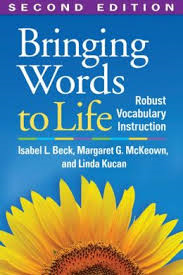
A few months ago, several of my lovely teacher bloggers recommended that I pick up the book Bringing Words To Life: Robust Vocabulary Instruction by Isabel L. Beck, Margaret G. McKeown, and Linda Kucan and boy, am I glad that I did!
http://www.amazon.com/Bringing-Words-Life-Second-Edition/dp/1462508162


I had done a post on vocabulary development within the Mystery genre for teaching story elements. Some of the activities I created were discussed in this book, and I had never even read it before! One strategy from the book is teaching your vocabulary words in the form of questions to create and facilitate discussion. Children need multiple exposures to vocabulary in a variety of ways. Using the questioning strategy with newly taught vocabulary opens up a level of interaction and engagement that will give language development a big boost. This is critical practice for children with language impairment or word retrieval issues.
After finishing Bringing Words To Life, I decided to create a set of question cards based on the book's suggestions with a series of generic questions where I could fill in any vocabulary words I needed. That way I would have them ready for any text. Then, I went a step further and created eight more cards for the book Penguin Chick by: Betty Tatham.

http://www.amazon.com/Penguin-Chick-Lets-Read---Find-Out-Science/dp/0064452069/ref=sr_1_1?s=books&ie=UTF8&qid=1390650574&sr=1-1&keywords=penguin+chick

This was a required text I used with my third graders. Although very high interest, the book had about 10 words that may seem new or present a challenge to some of my readers.

Here is a list of the Tier 2 and 3 vocabulary I selected to try the questioning strategy with Penguin Chick:
webbed, brood patch, rookery, tobogganing, krill, huddle, down, trumpets, preen, and creche.

You'll notice these words are a combination of both Tier 2 and Tier 3 vocabulary because some have multiple meanings, while others are content specific. Take a peek at the question cards:

Generic Question Cards: These questions would work really well with introducing character traits, since you'd probably need an adjective to fill in each blank.


Question Cards for Penguin Chick: These cards are more specific to the text, but provide a level of engagement where students have to use their knowledge of the book vocabulary to be able to discuss them in a meaningful way.


Sometimes when a student explains the meaning of a word, their explanation can seem tacit, or surface level. When creating vocabulary questions, I found these tips useful:
  • Keep questions open-ended.
  • Place the word in a "what if" scenario.
  • Create an "either or" questions or a "which would you rather" question.
  • Make a pros/cons question. "What are the benefits of...?"
  • Have a question that compares and contrasts the vocabulary word to another word.
  • Make sure your students are making a connection with the word by posing a question that asks them to rely on their schema.
Using the question cards raises their level of understanding, and really gets your children actively talking about words! You can use them at the beginning of a lesson as a whole class, pair students up and give them a card, or use them during a guided reading lesson.
Click the link below the image to print out a copy of the cards I created to use with your own students!
https://drive.google.com/file/d/0B1IfP1qg39PPSm9LRnlBLVVjd1k/edit?usp=sharing
 
 
I'd love to know how you incorporate effective strategies for teaching vocabulary in your classroom. Please share in the comments! Thank you for visiting Literacy Land today!


Unlock Your Brain: Activating Schema

Hi everyone! It's Melissa from Don't Let the Teacher Stay Up Late, and I'm so excited to share my first post on this blog. For those who don't know me, I've been teaching for 8 years in a small county near Richmond, VA. This is my second year as the Title I Reading Specialist for grades 3-5, but I spent most of my time in fourth grade. I love working with older kids and focusing on comprehension skills.


Today I want to share one of my favorite words: SCHEMA. When I began my master's program four years ago, I had never heard of the word. It's just a fancy word for prior knowledge, but it sounds so much more fun! As strong readers, it's not something we really think about because it just comes naturally to us. However, we got that way from LOTS of practice.

I like to teach schema at the very beginning of the year, and yes, I use the word schema because the kids think it's a cool word, too. Plus I tell them they can go home and teach their parents a new, fancy word. When I introduce it, I explain that schema just means "what we already know". I tell them it's like our brain is a filing cabinet and certain words tell our brain to pull out a file. Then I usually say "dinosaur" and ask them to tell me what things they thought about. They give a lengthy list (I don't write it down, but I would if the kids were a little younger). Then we discuss where they learned this information. I only said one word, but they were able to give me plenty of information.

After they have an understanding of what the word means, I show them how it applies to reading. I choose a book, and we activate our schema (I pretend to turn a key on my brain to open the filing cabinet) on the topic. I recommend beginning with a nonfiction book, and it's important that the topic is one your students are comfortable with. As they call out information, WRITE IT DOWN! You can have them write it on a sticky note and sort the information into categories, or you can just list the information. Then I show the students the book cover. That may jog their memory for a little more information.

I explain to the students that they will need this information to help them read the book. Sometimes it will help them understand words that are unfamiliar (context clues). Other times it will clear up information that the author doesn't completely explain (making inferences). I tell the students that good readers use their schema all the time. Before we read, I have them explain to me what schema means. I see a lot of them "unlock their brains".

The most important step is to begin every story that you read with the class by activating their schema. This doesn't have to be long, but they need PRACTICE!! This won't become a habit without a lot of modeling and practice. It's also important because there will be times when students don't have sufficient background knowledge, and they will need help BUILDING their schema.

A few recommendations for quick prior knowledge checks:

  • sticky notes
  • 20-30 seconds to share one fact with a buddy
  • draw three names to share one fact
  • short journal writing for morning work

Since this is my second year in this position, I've been able to see how much some of my students have retained from year to year. They don't always remember the word, but all I have to do is "unlock my brain" and they know exactly what to do. I've noticed that they are more engaged in the topic from the beginning, and it makes teaching future skills a lot easier!

What is your favorite book to practice activating prior knowledge?


Helping Students Stay on Topic

Hello new friends!  I am very excited to be joining a wonderful group of teacher bloggers as we embark on this new Literacy Land adventure.  I began my journey in education as a middle school social studies teacher.  I went to a professional development about incorporating reading strategies across content areas and I started thinking that maybe I wanted to teach reading instead.  That opportunity arose in my district and I became the seventh and eighth grade reading teacher.  Did I have any idea how to teach reading?  NO!  So I went back to school and got my master's degree in reading.  After teaching reading for a few years, I was given the opportunity to become a literacy coach for grades 4-7.  While I was coaching, I achieved National Board Certification in Reading/Language Arts.  Currently, I am a Master Teacher (instructional coach/facilitator...there are so many names that mean the same thing) for grades preschool through third grade.

As part of my job as a master teacher, I have to analyze our test data to determine an area that needs to be focused on school-wide.  Once I have narrowed down the focus, I research strategies that would help our students succeed in that area.  One of the great things about my job is that I don't just tell my teachers, "Go try out this strategy because this book/article/website said it would work."  I have to field test, or try it out, first with a group of students in our school.  Once I work the kinks out of the strategy, I present it to my teachers in manageable chunks.  Looking at the data, we were struggling with creating a piece of writing that stayed on topic and was organized.  What to do?

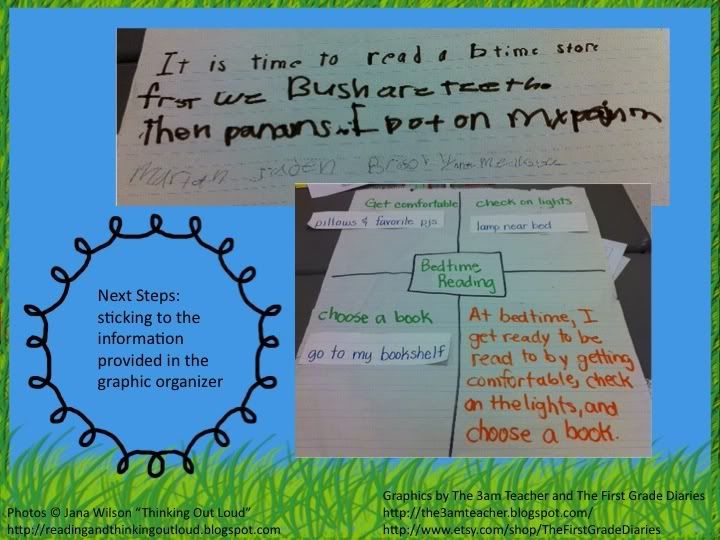
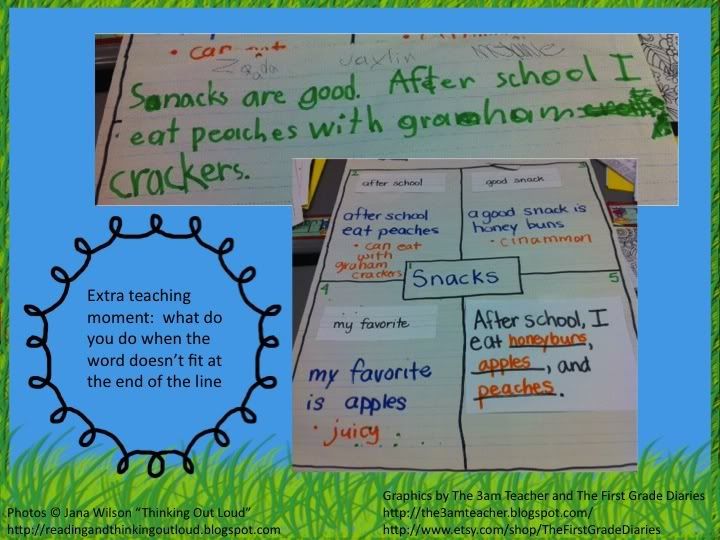
I researched and found the four square writing method and began to try it with the first grade students my first grade teacher graciously loaned to me.  We worked on using the graphic organizer for a couple of weeks before we picked one of the graphic organizers and wrote our first piece of text.

Step One:  Model, Model, Model
It doesn't matter what grade I teach, I am always impressed by the power of modeling.  I modeled how to turn the information in the graphic organizer into sentences to write the paragraph.

Step Two:  Guided Practice
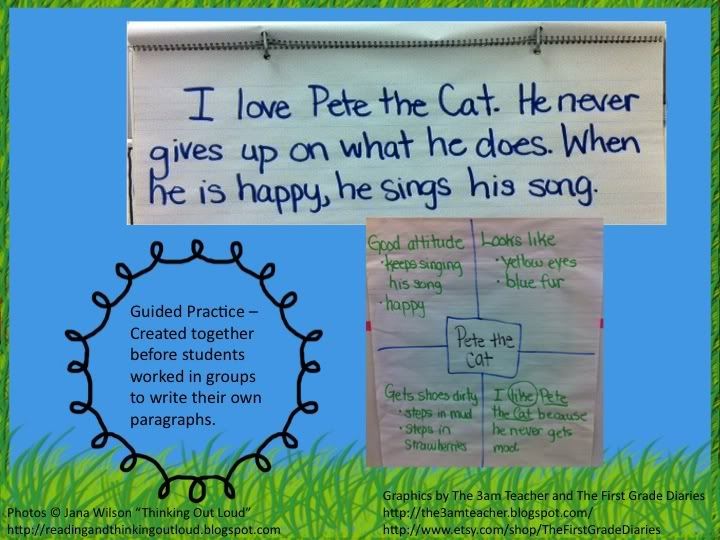
In the next lesson, the students and I worked together to start our paragraph.  We used a graphic organizer that we had previously completed together.  We only focused on the topic box and the first detail box.  The next lesson took the remaining boxes and turned them into sentences.  I wanted to take a piece at a time, so I had the opportunity to assess them before we wrote the whole paragraph.


Step Three:  Group Practice
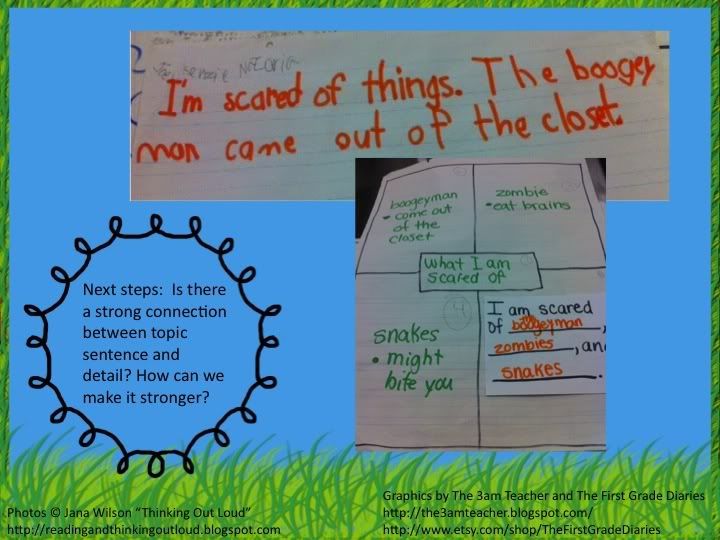
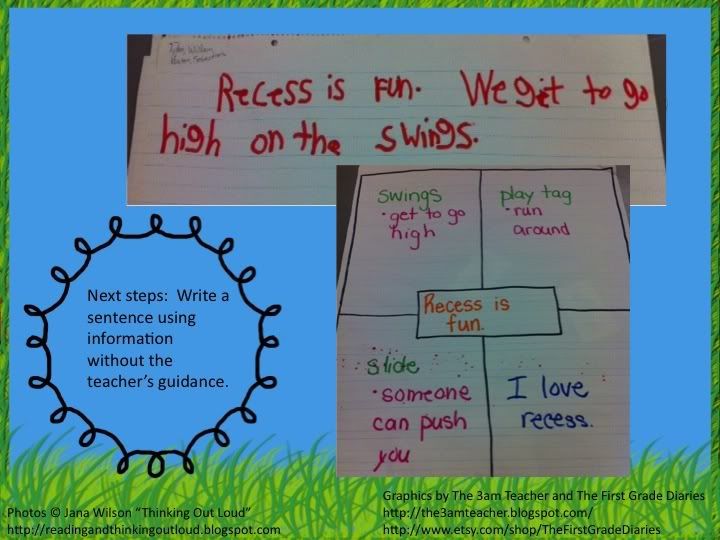
Before taking the plunge and having the students write their own paragraphs, I wanted to give them more practice by working together in groups.  Each group was given a different completed graphic organizer (each one had been completed during guided practice earlier in the unit).  They were also given a half-sheet of chart paper and a marker.  The groups had to write the beginning of the paragraph that would match their graphic organizer.  After they completed the beginning of the paragraph, I assess by reading and writing down next steps.  I used the next steps to plan my small group writing time.


Are these the best sentences ever?  No.  Could they use some style?  Yes.  Am I happy with the product?  Yes!  Our goal has been to make sure that the details they use in their writing match the topic.  The next steps are to finish this draft, revise, edit, and write a final published copy.  The published pieces are going to be displayed in the hallway.  All we are working on is content and I am pleased with our beginnings.

The students were excited about working together to create a piece of text.  One group finished quickly and asked for another graphic organizer.  They wanted to keep writing!  I left school with a smile on my face thinking about how excited they were to write.

What's next?
Now that students have experienced success creating a piece of text with a group, it is time to move them into independently going through this process.

I would love to hear how you help your students organize their writing and stay on topic.  Let me know in the comments.


http://readingandthinkingoutloud.blogspot.com

The Importance of Running Records


Hello my friends!  My name is Jennie from JD's Rockin' Readers.  I am very HONORED to be a part of this amazing group of literacy gurus!  We have been working and collaborating "behind the scenes" for a few months now and they are all truly amazing.  

A quick little bit about me.  This is my 14th year teaching.  I have taught 3rd grade reading, 2nd grade classroom, Reading Recovery, Title I Reading (1st grade), and 1st grade classroom.  I have also been trained in Literacy Collaborative.  Currently, I am working in a regular 1st grade classroom.  After teaching Reading Recovery/Title I Reading for the past 10 years, I was ready for a "change".  So, I chose to go back to the daily bump and grind of 20 six and seven year olds at one time.  I LOVE it, but I really feel like a first year teacher all over again!

I wanted to talk a little bit about Running Records today.  This is something that we all should be doing with our students regularly if you want to truly get to know each child as a reader.  Running Records were first created by Marie Clay (founder of Reading Recovery) as a way to analyze student reading behaviors while reading actual text.

The BEST person to do the running records on their students is the classroom teacher.  I know it is time consuming and can be difficult to keep the others working on something productive.  But, running records are the best way to analyze a child's reading behaviors.  We need to remember that running records capture a child's thinking.  We can then analyze the students behaviors and plan for appropriate instruction.  They also help teachers to find appropriate text to group (and regroup) students for guided reading.  Benchmark assessments (using running records) also help document a student's growth over time.

(Button credits:  3am Teacher, Scrappin' Doodles, Dancing Crayon Designs, Kevin and Amanda)

Some things to remember:
  • You want to observe the child and record what he/she is doing INDEPENDENTLY as a reader. There is no helping them to solve words- only recording the behaviors.
  • Try to make the atmosphere as relaxed as possible with no interruptions.  
  • Record everything that the child does.  This should not only include the reading errors, but also other behaviors such as body language, attitude, and attention.
  • After the reading, have a natural conversation about the book rather than just asking questions.  This will allow for deeper thinking about the text.

There are pretty universal "markings" to record reading behaviors.  When Marie Clay first started recording students' reading, there were no "assessments/papers" that already had the words for the teacher to use and record on the students' reading.  She used a blank page.  This is why she chose to make checkmarks when the student read a word correctly.  Today, it is a little different.  IF you have the words to the text in front of you, you do not HAVE to put the checks above each word.  Ultimately, it doesn't make a difference IF the words are already there.  Something I like to do instead is make a line under the words as they read them.  I make a continuous line if the child is reading in a phrase.  For example:

The big dog  ate his bone.  (This tells me the student is reading in three word phrases.)
or
The  big  dog  ate  his  bone.  (This tells me the student is reading word by word.)

If you are doing a running record on a book that is not a benchmark and there are no words.  I would suggest using the checkmark system.  This way, you can go back into the text and analyze the errors that the student has made.  


If you are doing running records in your classroom, make sure that you understand the difference between Errors and Self-Corrections and the general rules of Running Records.   These can be found in your assessment kits or on many sites online.

Some common questions that I hear from other teachers about how to record and score running records include:

1.  Do names count as an error?   Proper names count as one error.  If a child says Pat for Pam several times while reading the same text, it only counts as one error.  Even if this child says Pat and then Pete and then Phil for the name Pam, it still only counts as one error.

2.  How do I count contractions?  If a child reads "do not" for don't, it counts as one error and visa versa.

3.  Self-corrections are NOT also counted as errors.

4.  What if a child appeals to me for the word?  If a child appeals to the teacher for help, you may say "You try it".  This does not count as an error (unless they then say the wrong word or need to be told), but you should record an "A" above the word so that you know they are appealing for help.  If the student still appeals, tell him the word and move on.


This is probably the most important part of running records.  I like to take a minute or two immediately following the students reading to write down my immediate thoughts.  This may include how fluently (or not so fluently) they read, what strategies the child is using at difficulty, or if the child is appealing for help way too often. 

 I always ask myself, "What can I praise this child for with his reading AND what can I teach him right now?"


In our District, we do Fountas and Pinnell Benchmark Assessments 3 times a year (unless the students need more intense intervention).  We are on trimesters rather than quarters.  We use Benchmark data from the end of the previous year to help form our reading groups in the fall.  I know many students may regress and others will progress over the summer but this information gives us a general idea of where they are as readers.  We quickly learn if they need to be moved to another reading group as we work with them.  We do not do benchmarks at the beginning of the year because it is just too difficult to spend the time when we are trying to teach rules and routines.  **I am not saying that you shouldn't do them at the beginning of the year- that is a personal and district preference.  This is just what works best for us.  Formal benchmarks should only be done 3 to 4 times a year.

Running Records should be taken on a regular basis during your guided reading groups.  This can be done at the beginning of the guided reading lesson.  Listen to one student in each group each day.  They can read the book that was introduced the last time you met (so it will be their second read).  Use a blank running record sheet if you don't have one with the words from the book you used.  You can download one that I made by clicking on the picture.
I keep all of my Running Records in a binder divided by students.  I keep the newest record on top.  I also record all benchmark assessments on a chart, and then this information is passed on to the next year's teacher.  This allows the teacher to see what areas the student has struggled with in the past and a quick overview of their reading progress from previous years.  This chart follows them from K-4th grade.

Here are a couple of pictures from my binder.


This is the graph we use.  It has all of the Fountas and Pinnell benchmark books.  The shaded areas (or above) are where we would like them to be reading.  We record these three times a year (first, second, and third trimester).  


This is on the back of the graph.  I record all of the BENCHMARK assessments that I give onto this paper even if they don't pass.  This allows me to quickly see what the last assessment I gave was and why a student didn't go up to the next level.  This is the paper that gets passed on to the next year's teacher and will follow them from K-4th grade.


I then keep all of that student's running records behind their graph with the most recent one on top, including any running records from guided reading groups.

If you are interested in seeing how I set up my Guided Reading Binder (which is a freebie).  Come and check out this blog post.


What is the hardest part about running records for you?  What other questions do you have about running records?


Point of View - It Makes all the Difference!

"Wait, not everything we read in newspapers and magazines is true?! But aren't those supposed to be nonfiction?!" These are the sorts of responses I heard from my fifth graders as I taught the following lesson on point of view. Up until this point, my students had never considered the skewed perspectives authors often present in their writing. (This also happens to be a Common Core standard!)

CCSS.ELA-Literacy.RI.5.6 Analyze multiple accounts of the same event or topic, noting important similarities and differences in the point of view they represent.

Mentor Texts with Lively Leads


Introduction

Hi! My name is Wendy D., and I am joining this highly talented group of teachers and reading specialists from Ms. D's Literacy Lab.  Before moving to the Boston area, I resided in Texas. I taught Head Start, Pre-Kindergarten, Kindergarten, First Grade and Reading Recovery over a time period of seven to eight years. I loved ( and still love) reading aloud a new picture book to students or seeing if they are amused with the same funny parts of a chapter book as I am. After moving to Massachusetts, I went to Lesley University and worked as a Graduate Assistant for Dr. Irene Fountas while she was writing her Guiding Readers and Writers book for intermediate readers and writers. After graduating with my Master's Degree in Reading (K-12), I have worked as a Literacy Coach for eight years and a Reading Specialist for thirteen years in a diverse, suburban, Title I elementary school near Boston. I love it!

 Leads 

Leads can be one of the most challenging parts of writing for students. Over the years, I have noticed that those students who read notable books have an easier time writing a lead because they have been exposed to so many different types of writing styles and authors.  In order to introduce leads to students in any grade level, I like to read a variety of exemplar texts during read-aloud time and revisit them during Writer's Workshop time.

Lucy Calkins states, "When upper-elementary students draft and revise leads, they are doing so not only with an eye toward a good lead but also because they recognize that each lead represents a different way the text could go: "If I start it this way, it'll take too long to get to the main part."        Units of Study for Teaching Writing, Grade by Grade series, 2013


When teaching writing, one way to expose students to different types of leads is to categorize them. I like to categorize leads into three different categories for students.

Mentor Texts with Lively Leads

Character Leads or Topic Leads (Nonfiction)

A character or topic lead is introduced in the first few lines of text with descriptive language that makes a reader want to keep reading and learn more.

"Have you ever wondered about turkeys? Where are the wild turkeys found and how do they live? What do turkeys eat? ... This book answers these questions about turkeys and more."
--All About Turkeys by Jim Arnosky

"From the beginning the baby was a disappointment to her mother. She was born red and wrinkled, an ugly little thing. And she was not a boy."
--Eleanor by Barbara Cooney

"Out in the hottest, dustiest part of town is an orphanage run by a female person nasty enough to scare night into day."
--Saving Sweetness by Diane Stanley

Time and Setting Leads


A time or setting lead is introduced at the beginning of the story and gives the reader background knowledge on where the story takes place.

"The Barefoot didn't see the eyes watching him as he ran onto the overgrown pathway.  His breath came in great gasps.  In the house since he had run from the plantation, he had traveled faster and farther than ever in his life."
--Barefoot: Escape on the Underground Railroad by Pamela D. Edwards

"One day, my dad looked out at the endless desert and decided then and there to build a baseball field."
--Baseball Saved Us by Ken Mochizuki

Challenge Leads


A challenge lead is a short sentence with exact words that implores the reader to read on. It is such an interesting start that a reader can't wait to read more.

" Everybody knows the story of the Three Little Pigs.Or at least they think they do."
--The True Story of the Three Little Pigs by Jon Scieszka

"It should have been a perfect summer."
--Enemy Pie by Derek Munson

 Mini-Lesson Idea for Writer's Workshop:


Choose a few favorite read-alouds from your class and revisit them. After reading the lead and a bit of the text, discuss with your students what makes this lead grab your attention. Begin to classify them on chart paper and post them in your writing center.

As a follow-up, students can begin adding leads from their own independent texts. In addition, they need to be prepared to explain why they thought it was a character/topic lead, setting/time lead, or challenge lead, as well as why it grabbed their attention and caused them to read on.

What is one of your favorite books to teach leads?