Shedding Light On Dyslexia: An Overview by The Reading Tutor/OG

http://thereadingtutorog.blogspot.com

Greetings from Literacy Land everyone! Emily, from The Reading Tutor/OG here. Today I'm going to shed light on a misunderstood topic in education: dyslexia. Before I begin, I would like to say I have not and will not diagnose dyslexia. Rather, I will dispel some myths, share my knowledge, the red flags to watch for in a reader, and provide helpful resources for you to educate yourself.


I became very interested in learning more about how to help the students in my classroom who were clearly dyslexic back in 2003. That year, a groundbreaking book came out called Overcoming Dyslexia by Dr. Sally Shaywitz, a developmental pediatrician at Yale University. I joined a book group at the school I was teaching at with about 15 other teachers. We were committed to figuring out the best way to help these students. I also took training in Project Read Phonology that same year to learn how to use a multisensory phonics approach in my own classroom.

Several years later, I knew I needed more training in how to accommodate these children. Even with my Master's degree in Literacy, we never received any formal training on how to provide best teaching practices for the dyslexic reader. Unfortunately, I realize this has been fairly common, but colleges and universities are beginning to take steps to educate their teachers about dyslexia in new and promising ways. I made the personal decision to become Orton-Gillingham certified. This training made me better equipped to work with my students in ways I hadn't realized before. My journey as an educator learning about dyslexia is ever-changing, exciting, and even a little sad sometimes, but a necessary one if I am to work with all kinds of readers to help them succeed.

First, let me share some myths about dyslexia.
Myth #1. Dyslexia is uncommon 
Truth: Of all the language-based disabilities, dyslexia is the most common, affecting about 15% of the U.S. population.

Myth #2. Dyslexia is when you see words backwards or reverse letters, so it's a visual problem.
Truth: Lots of early readers reverse letters, but this is not a sign that they are dyslexic. Dyslexic readers have difficulty at the phonological level. They may not have a hard time seeing the words, but they have trouble manipulating the sounds in the words. Although many dyslexic readers state letters may appear to look strangely on a page when presented in certain fonts and font sizes.

Myth #3. Dyslexic readers can't be taught how to read.
Truth: Provided that proper identification and intervention is provided (as early as possible in a child's school career) dyslexic readers absolutely can be taught how to read.

Myth #4. If you are smart and perform well in school, you can't be dyslexic.
Truth: Dyslexia affects students from all levels of intelligence, backgrounds and genders equally.
Source and for more myths

Here are more important facts to keep in mind:
1. Dyslexia is hereditary. If you, your spouse or close relative have dyslexia, your child has a higher chance of having it too.
2. About 1 in 5 people have dyslexia, but only about 1 in 10 people will qualify to receive proper intervention for it.
3. Early detection and intervention is key.
4. Thanks to MRIs, we now know that the dyslexic brain processes information in a different part of the brain than a non-dyslexic.

So what is dyslexia? Here is the formal definition:

Dyslexia is a specific learning disability that is neurobiological in origin. It is characterized by difficulties with accurate and/or fluent word recognition and by poor spelling and decoding abilities. These difficulties typically result in the phonological component of language that is often unexpected in relation to other cognitive abilities and the provision of classroom instruction. Secondary consequences may include problems in reading comprehension, and reduced reading experience can impede growth of vocabulary and background knowledge. (Annals of Dyslexia, Vol. 53, 2003)

 *I actually had to memorize this definition in my Orton-Gillingham training, and was glad they made us. I can still rattle it off. :)
Watch this short, but powerful video from my Dyslexia Support Board on Pinterest.

What are some red flags for dyslexia?
(Note: This is a small list, but it has some common symptoms you may be seeing in a student you suspect that has dyslexia. See the link below for more characteristics.)
1. Extremely slow reading, poor reading fluency, which affects overall comprehension
2. Weak spelling and decoding
3. Poor phonemic awareness and phonological awareness 
4. Difficulty with word retrieval, letter name and sound recognition
5. Difficulty with recognizing rhymes
What are some strengths people with dyslexia may have?
  • Most dyslexic readers have average to above average intelligence.
  • They are creative, think outside the box thinkers.
  • Strong visual-spatial abilities
  • They have the ability to link abstract ideas together.
Where can I go to learn more?
I highly recommend the following books and websites to educate yourself about dyslexia.
We know more about dyslexia than ever thanks to research, and the books and websites above. Reading is not an innate ability for humans like walking. There are aspects that have to be explicitly taught. How do we go about helping these unique readers? Here are a few things to keep in mind.
  • Use a structured, systematic, multi-sensory approach to teaching phonemic awareness, phonics, reading, spelling, writing, and handwriting. This is good teaching for all readers, not just for dyslexic learners. There is a large volume of research to support this as best practice. Orton Gillingham is one well respected approach that has been used effectively for years. Here is a link to one O-G informational site.
  • Provide consistent fluency intervention. I wrote a post on my blog about specific fluency programs if you're interested.  
  • Keep audio text readily available in a variety of formats. (listening centers, a computer station, on a mobile tablet)  Many dyslexic readers are ear readers. When they hear the text and follow along in order they'll gain the most benefits.
  • Expose children to all kinds of text such as magazines, graphic novels, and comics. They may enjoy a different format other than the traditional chapter book, which can seem daunting.
  • As parents, continue reading aloud to your child at night so they hear a proficient reader. These children may have strong listening comprehension, so choose books that are above their reading level to read to them, and foster a love of lifelong reading and learning.
  • Use assistive technologies. Check this Pinterest link to apps that may help a dyslexic reader.
Please remember:
  • Every dyslexia reader is different.
  • Some reading disabilities are more severe than others.
  • Certain instructional approaches will work better than others. Find out what is research based and works well, and use it consistently.
  • Your dyslexic students have real strengths! Take time to find out what they are help your students or child to embrace them. 

I'm happy to answer your questions and welcome your feedback. I hope this brief overview provided some insight into helping your most challenged readers. I post information about dyslexia regularly on my Facebook page it you're interested. I hope you'll check it out soon. You can also visit and follow my blog. Thank you for reading my post today!


photo source: www.morguefile.com


Fact and Opinion: Not as Easy as it Seems

 Hi, it's Melissa from Don't Let the Teacher Stay Up Late here to share some tips and a little tool for teaching Fact and Opinion!

I don't know about you, but this is a skill that my students really struggle with all of a sudden when they reach 4th or 5th grade. They can tell me the difference between the two and even give me examples. They even THINK they are really good at it and will sometimes say it's easy. But don't be so quick to take their word! I'm going to walk you through some quick steps to teach and review fact and opinion so that your students can be more successful, even when the examples go past, "Yellow is the best color." and "The sky is blue."

First, make sure they have a STRONG understanding of what fact and opinion looks like. This means you need to go beyond definitions and help them identify traits and clue words.


Amber Polk has a great freebie on TPT that I love to use for this. It includes definitions and characteristics that students can sort under correct categories. Then they can also put everything into an interactive notebook to refer back to later on! Click on the picture to find her freebie.


After students understand characteristics, have them begin to identify examples from text they are reading. But don't stop there! Students need to be able to explain why to reinforce their understanding. Have students highlight key words and/or write what traits are present in the sentence (specific event, date, etc). For facts, I ask my students to tell me how they could prove it is true. If the fact says, "More Olympic events take place in the summer than winter", students could say that they would look for a list of Olympic events sorted by the seasons.

To help students practice proving fact and opinion, I created this simple graphic organizer to share with you. There are two versions: one includes clipart with Si from Duck Dynasty, and the other is plain. I will keep this as a freebie forever, so don't worry about it disappearing on you!

Fact and Opinion Graphic Organizer

What other comprehension skills do you notice students struggle to master?


The Importance of Syllables and Freebies !


My "AHA" moment around Syllables
     As I glide through this year, I began noticing a relationship between playing with syllables in the younger grades and understanding how to chunk words into syllables at the upper grades. I have noticed that as teachers explicitly teach phonemic segmentation  and nonsense words, the students gain a greater understanding about syllables. Gradually over time, first and second grade students seem more confident in their abilities to segment words into syllables as they begin to read words with multiple syllables.

   My "AHA" moment came as I was getting ready to write this post! When students in grades 2-5 realize that the clapping syllables and separating them into categories in younger grades supports them into breaking words into syllable types at the older grades... decoding may become easier for our older struggling readers.  

   An older student may benefit from explicit instruction in different types of syllables if he/she is only paying attention to the beginning or ending of words in oral reading. In addition, if their substitutions don't make sense within the sentence, it may be that the student is only attending to part of the visual cue.

   So, let's start off this post by looking and learning about the 6 syllable types...

The 6 Types of Syllables

1. Closed Syllable-- a syllable with 1 vowel followed by 1 or more consonants. A consonant, consonant blend, or consonant blend may be in front of the vowel or not. The vowel makes it's short sound and is marked with a breve.
  
Examples include: cat, hog, ask, chip, flop

After students learn the CVC rule and the basic closed syllable, they are introduced to consonant digraphs, consonant blends, and the exceptions to the closed syllable rule.

2. Vowel-Consonant-E Syllable-- a syllable that has one vowel followed by a consonant then an "e". The final "e" makes the vowel say its name, or it's long sound, and the "e" s silent. The vowel is marked with a macron.

Examples include: ride, throne, jute, shine, grade, smile

3. Open Syllables-a syllable that ends with 1 vowel. The vowel is long and is marked with a macron. This is the stage where students learn that "y" at the end of a word acts as a vowel sound. In a one    syllable word, a final "y" at the end of a word usually makes the long "i" sound.

Examples include: hi, me, shy, flu, she, cry

In a 2 syllable word, such as funny, baby, candy, the final "y" usually makes the long "e" sound.
  
4. Consonant -Le Syllable-- This syllable has a consonant followed by "le"  and it's the last syllable in the word. There are only 3 letters in this syllable. The final "e" is silent and syllable sounds like a blend as in the word, "muzzle".

Examples include: dribble, cable, puzzle, apple, tremble

5. Vowel-R Syllable: This syllable has a vowel followed by an "r". These are also known as "r-controlled vowels" and they don't have a short or long sound. The "r" controls the vowel so it makes a different sound. The sounds of "er" ,"ir" and "ur" sound similar. This set of words can be difficult for students to learn to spell.

Examples include: star, turn, bird, fern, short

It is common for students to try to read these syllables as a closed syllable. A prompt to look at the consonant after the vowel to see the "r": "It could be a closed syllable, but look at the letter after the vowel."

6. Vowel Team or Double Vowel Syllables--This syllable has two vowels that make one sound within the word. It is important to teach these sounds separately  as not all of the pairs follow the "When two vowels go walking the first ones does the talking" rule. Actually, only 40% of the vowel teams follow the "walking and talking" rule.

Examples include: foot, seed, sauce, tail, coin

 Two Freebies to support you in teaching syllables:


  1. The Six Syllable Types- Mini Poster
2. A Sweet Treat for sorting open and closed syllables with the Long Vowel Sound of "y" -- Head on over to our Facebook page and download this fan freebie until February 14, 2014
 https://www.facebook.com/adventuresinliteracyland


What types of Word Work or Syllable Activities do you do in your teaching? Please comment below!


Pinning Down Prosody with Poetry

http://readerstars.blogspot.com


Hello, everyone!  Andrea here from Reading Toward the Stars to focus on an important aspect of:

What is prosody?  Merriam-Webster says that it is the rhythm and pattern of sounds of poetry and language.  But, what does that mean when we are teaching students to read?

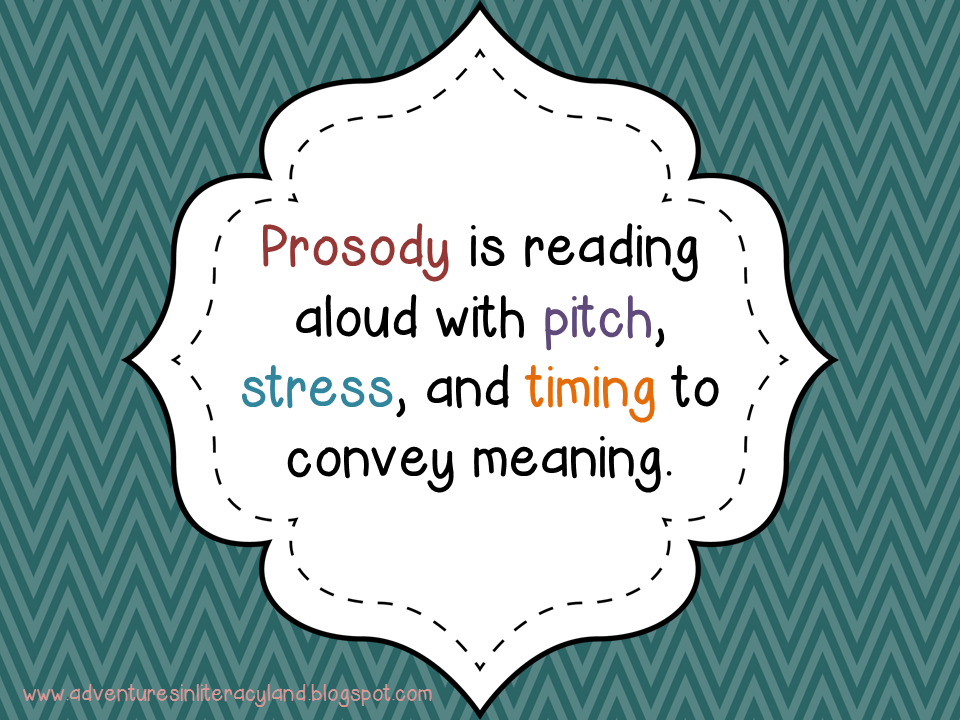
So many times when we teach fluency, the students think we just want them to read fast, but fluency is so much more than reading fast.   We want students to read at a steady pace, not too fast; not too slow; but just right.  To achieve this, we have to teach our students prosody:  pitch, stress, and timing to convey meaning when reading aloud.
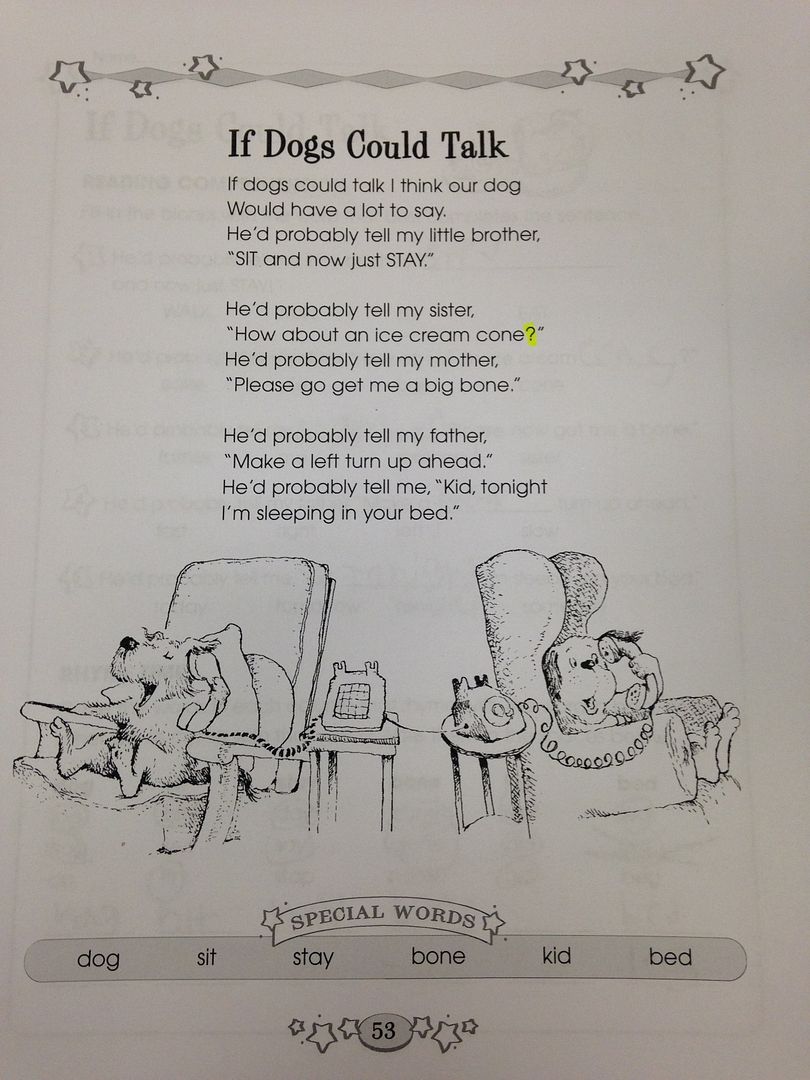
Every week, my various student groups work with poetry.  On the first day we either read the poem together or choral read the poem, depending on the grade level.  We talk about the poem to make sure we understand it.  Throughout the week, we do various activities with the poem, like search for special words {sight words, important words, suffixes, prefixes, contractions, rhyming, etc.}.

My third graders need a lot of work with prosody.  They know the words in the poems, for the most part, but really need help with prosody.  Many times they just zip through what they are reading and don't take time to think about how it should sound.  I have started using one of my tried and true favorites for helping students with prosody ~ coding punctuation.

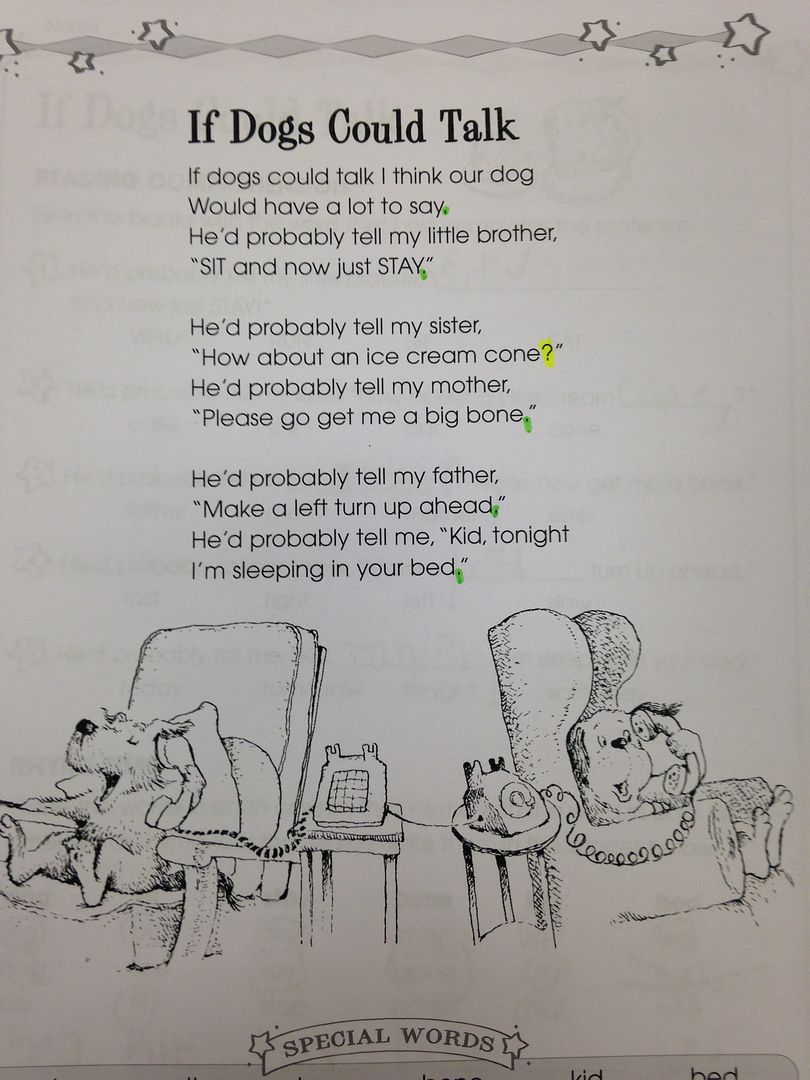
We love to highlight different words in the poems, but my students really liked highlighting punctuation and then reading the poem like it should sound.  After reading the poem really quickly, I had the students find the various types of punctuation in the poem.

We started with the question mark and talked about how it would sound when we read it.  We highlighted it and practiced that one line as a question and not as a question.  We talked about how it should sound and why.

Then we moved on to mark all of the periods in the poem and talked about how we needed to take a breath.  We practiced the poem with and without the periods.  So funny to hear them almost lose their breath without the periods!

The last thing we coded were the words in all caps. We talked about how we needed to read them loudly, as if we were shouting.  Then we practiced it.  This was, by far, their favorite!

I reminded my group that they did not just have to read like this with poetry, but that they should read like this ALL the time.  I gave them these bookmarks to keep with them to help them remember how to read with prosody, or emotion as we call it.  You can grab this freebie {here} or by clicking on the picture below.
https://www.dropbox.com/s/9idgj64agzusyy3/fluency%20bookmark.pdf

I want to leave you with some great places to get some free poems and passages to help students read with emotion.


Enjoy these resources to help your students gain prosody, an important part of fluency!

What are some ways you help your students gain prosody while reading?


http://readerstars.blogspot.com

Freebie Fridays

Classroom Freebies Manic Monday

Falling in Love with Vocabulary

Thanks for visiting Literacy Land!  I'm Wendy from Read With Me ABC, and I'm thrilled to be sharing ideas for building vocabulary knowledge with you today.

Before I share my post, please allow me to me tell you a little bit about myself.  I have been an elementary teacher for the past 20 years. Although I've taught many different grade levels, I'll always consider myself a first grade teacher since most of my years have been spent there.  However, a few years ago I accepted a position as a reading specialist, doing what I love best, teaching children to read.  I work with developing readers in grades 1-5.  I truly consider this my dream position!  

Call me unusual, but I think vocabulary acquisition is fascinating.  I love learning new words and playing word games. I'm a self-proclaimed word nerd.

As teachers, we know that vocabulary is critical to reading comprehension. It plays an important role in learning to read as well as reading to learn. To ensure academic success, young readers must develop a wide base of word knowledge and the ability to learn how to acquire new words.

So, how do we foster vocabulary development?  Students often don't share my enthusiasm for learning vocabulary.  ;)  The challenge is to create high-interest, engaging lessons that children will love.


Students need direct and indirect instruction in vocabulary, as well as multiple exposures to the words, in order to internalize the meanings. The routine I use in my classroom is based on Six Steps to Effective Vocabulary Instruction developed by Robert Marzano.  Students seem to embrace the six-step routine and fall in love with the activities, discussions, and games we play to acquire new vocabulary.  Perhaps this approach will work well for you too.


1. Provide a Description, Explanation, or Example:  Introduce the word and supply a kid-friendly definition, description, or explanation.  Use the word in a sentence.  Give several meaningful examples. 

Ideally, I like to introduce words within the context of the story we are reading. This is the perfect time to introduce a word with which students may be unfamiliar.  After a little "word- talk", I'll display the word on a concept map.  We focus on two or three words per story and add the words to the map throughout the unit.  


2. Students Apply the Word:  Ask students to demonstrate understanding of the word by restating the description, explaining its meaning, or giving an example in their own words.  Encourage discussion, use of white boards, and vocabulary journals.


3. Students Draw the Word:  Invite students to draw a small picture or symbol that represents the word.  Model this process with your own drawings.  Use white boards so students can get ideas from each other. My students record their words, definitions, and pictures in a variety of different organizers that can be added to their interactive notebooks. Here are a few examples...


4. Students Engage in Activities to Extend and Refine Their Understanding of the Words:  Return to the words frequently with activities to refine, extend, and deepen student understanding of the words.  Point out the words as they are encountered in text.  Examine each word in depth.  Highlight prefixes, suffixes, and root words that will help students remember the meanings.  List related words.  Identify antonyms and synonyms.  Sort or classify words.  Compare similarities and differences.  Construct sentences using the words.


5. Students Discuss the Words with One Another:  Encourage students to use the words when writing or speaking.  Ask questions that require students to use the words.  

Students can use the "Think, Pair, Share" strategy to describe the pictures they've drawn, compare their descriptions of the words, and discuss any confusions or 'a-ha' moments they've had with the words.


6. Involve Students in Games:  Provide opportunities for students to play with the words and reinforce their word knowledge.  As you can imagine, this is the most popular step with students.  Many of the games we play are based on popular board games and TV game shows.  Here are a few of our favorites.
  • Memory
  • Pictionary
  • Charades
  • Jeopardy
  • $100,000 Pyramid
  • Password
  • Bingo
  • Swat
  • Blurt!
  • I Have... Who has?
  • Heads Up
Of course, we can't teach our students every word they'll ever need to know, but we can provide the scaffolding they need to successfully acquire new words and foster a love of vocabulary.  

Here are a few resources that I have found helpful for teaching vocabulary:

Would you like more ideas for vocabulary instruction? Emily wrote about using focused questioning to develop vocabulary in {this post} and Jenny, Deniece, and Jana discussed vocabulary strategies {here}. Check these posts out; you'll be so glad you did. :)

Do you have a vocabulary activity or game you play with your students? Please share your idea in the comments. We would love to hear from you!


*A very special thanks to EduClipsLovin' Lit, and KG Fonts for the graphics used in this post. 

RTI Documentation- Tier 3


Does your brain just start to go crazy when you hear the words DOCUMENTATION??  I know mine does.  Documentation is becoming more necessary than ever before in education.  We have those kiddos that just don't seem to be catching on and we HAVE to find out what makes it "click" for them.  They will learn to read, but unfortunately it isn't an automatic skills for many children.

I think most schools have some sort of team of teachers that work together to find supportive ways to help the kids that are struggling.  Your team may be your RTI team.  Our team is called IBS and honestly I don't even remember what it stands for (Intervention Based Support??? maybe??? I really don't remember).  We always seem to refer to it as Irritable Bowel Syndrome… please don't take that wrong, it's just a good way for us to laugh.

Anyway, for those kids that have been moved to Tier 3 intervention and need to have very purposeful interventions, documentation is a must.  These interventions need to be documented.  I made some simple documentation pages that could be used for any subject.  Simply print off and document the lessons and interventions that you have done with the child.

Click on the picture to get the FREEBIE!


Last year, I had a student who was really struggling with sight words.  I was providing specific intervention with sight words.  She would get many of them confused and they are definitely not automatic in her reading.  This student is a good artist and loves to draw so I wanted to use her strengths to help her get excited about learning these words that were difficult for her.  

The first page of the progress monitoring plan is basic information.  This page describes the students strengths/weaknesses, skills needed to succeed, and intervention skills that you will be specifically working on.  This page also allows you to document what the intervention will be, who is providing the intervention, how often, and what assessments you will use to monitor the progress.  Here is a sample of my student struggling with sight words. 


When I make copies, I copy page 1 and page 2 back to back.  Page 2 is where I record the Assessment Data and my progress monitoring notes.  For this intervention, I used my sight word lists (I use Lucy Calkins list from The Teachers College of Reading and Writing).  You can check out my post here that tells why I choose to use her list over Dolch and Fry.  I also looked at her Reading Benchmark Book running record to see if she is reading the sight words correctly in text.


Page 3 is where I do my daily documentation.  This example is over about a month.  Unfortunately, I didn't see B. L. as much as I had hoped.  She was sick for a few days and I was out with a sick child for a couple days as well.  And- I think we had a couple of snow days... anyway this is what I have documented.  For her intervention I made different flashcards to help her put a visual picture with her sight words.   She would have the word and would draw a picture to go with the word to help her remember it.  Then, after practice, we would take the picture away.  

If you would like to download this sample, click {here}.

I hope this will help you keep organized with your documentation.  What things do you do to stay organized with your Tier 3 kids?


Lighting up Learning Family Style

Looking for parental involvement ideas? Look no further. This post include five simple ideas that your parents will love.

School can and should be fun, and it should be a place where everyone is included in the process and welcome regardless of ethnicity, socioeconomic status, or level of education. Our school district's motto speaks to this, "Every Child by Name and by Need to Graduation", and educating our children takes a village.  Here are a few ideas from my fellow contributors that you might consider to help improve the home-school-community connection.