A Lesson with Tanny McGregor

Throughout the life of our Literacy Land blog we have posted several times about the lessons within the Comprehension Connections book by Tanny McGregor.  Her lessons have proven to make comprehension strategies "come alive" for my students.

Several months ago Tanny asked to do a lesson with my students....ummmm....YES!!!!

Her lesson centered around theme and my students left with a strong foundation of the meaning and purpose behind theme.  I go into great detail about the lesson and everything that took place over at Curious Firsties.

Within the lesson, Tanny used three different texts.  She called them "text cousins."
They were text cousins because they were each different but share the same possible or similar theme (much like cousins).  She explained this visually with a triangle and a heart.  The three texts make up the triangle and the heart is the "deeper" piece that they share.

She started with the poem.  The students heard the poem, read the poem about 2-3 times.  Then they had a quick discussion about the theme.  When Tanny moved on to the second text, Each Kindness, she used only the illustrations.  And not even all the illustrations.  Just a few of them.  Then students had a discussion about theme.  The third text used was Red.  Tanny read this story aloud and stopped briefly at certain points to discuss what was happening.  Then there was a discussion about the theme.

Now, there was much, much more to the lesson than this.  But the WAY that she used the texts sent me a powerful message.  And it got me thinking...

The lesson was probably 45ish minutes long (I was not watching the clock). Tanny used three different types of texts in one lesson within that time frame.  Each piece of text was provided so much meaning and connected well to the lesson.

The poem by Jeff Moss was short but immediately the students understood that someone was being left out, someone was being picked on, and someone was being mean.

I have no idea about the actual story from, Each Kindness, but we gathered quite a bit of information from the illustrations.  A quick discussion and some "turn and talk" time was completely sufficient for the students to make connections between the poem and illustrations.

The third text was read in its entirety.  Red was a beautiful story about the strength that children can have and it served as an excellent way to bring all three texts together.  But Tanny did not have to stop on each page and have a discussion for these connections to be made.  The story was powerful and clear enough on its own.

As I reflected on the lesson, materials, and pacing, I realized that I would not have thought to use multiple texts in one sitting, in one lesson.  I tend to use multiple sources over a period of days.  And I would never look at only a few illustrations from a picture book.  No way!! I would read the whole story, of course.

This lesson opened my eyes.

When planning lessons, I need to think outside my comfort zone.  Look at how I can make these text to text connections stronger for students by using multiple sources of information.  My teammate, Karen, decided that she could pair some nonfiction texts with fiction texts by merely using certain aspects of books (such as photographs, maps, or diagrams).  I will be sitting on this new learning for a little while.  I have a good feeling that it will be changing the way I approach lessons.

What are your thoughts?  Do any book pairs come to mind right away?



Centers for Upper Elementary Classrooms

Hi, it's Melissa from Don't Let the Teacher Stay Up Late! I know many of you are winding down your school year at this point. We are in full review mode here in Virginia with state tests right around the corner (3 weeks away - yikes!). With review time, I like to pull out centers for students to rotate through where we can touch on a variety of skills at different times. Here are a few tips for centers that don't take a ton of prep time and are valuable to the students at the same time.

1. Don't underestimate the value of a simple "Read to Self" station. I know it may seem like a cop-out, but studies have proven time and time again that having students read and make their own choices on what books they select is the most effective way to create life-long learners! Maybe have a nice, cozy reading area (if you have that luxury), or just get a few pillows. I just let them choose a place around the classroom. You'd be surprised how excited 4th graders get about reading under their desk. No money spent, and everyone is happy! I would say this is a MUST station, whether you have all children do it at once or include it in your rotations or both.

2. Games are okay! I have some fantastic Reading Comprehension board games from Edupress, and my students love them. We pull them out frequently. Each game includes a set of cards with short passages and multiple choice answers (so basically test-prep). I make the students hold on to cards that they answer correctly to see how well they are doing with the skill. This is an ideal center for this time of year when many students (and teachers) are burnt out on regular test prep passages and practice sets. I actually pull them out even more at this point.

3. Find Reading Centers on TPT or create your own. I have created centers for almost every month, and I print and laminate them to put in colorful folders for students to grab and use throughout the year. Yes, it takes a lot of prep at first (whether it's actually creating them or just putting them together after purchasing), but these are great ways to practice different skills that you are working on throughout the year, and there are TONS of great options online! I like to include a graphic organizer with my centers so I can monitor their progress.


4. Computers/Listen to Reading. It may sound "babyish" to have students listen to reading at this age, but they still love it and can benefit. See if your school has Tumblebooks or check with your local library. I also have used www.storylineonline.com, which has popular picture books read by celebrities. You can also use this time for one of the MANY great websites (free or paid). We just recently started using Raz-Kids, which is well worth the money in my opinion! It has a great selection of short, leveled books for students to read (or even have read to them), and then they answer a few questions about the book at the end. Students can earn points for completing books and questions, and then they get to use the points for fun activities on the website!

5. Last, but not least, make wise choices with your teacher station. You may choose to do small groups or individual conferences. I would do a mix. My station almost never looks the same. During individual conferences, I am usually listening to a student read a book they selected, and then we discuss what they need to work on. However, I also pull students or groups to work on specific areas of weakness. We may go through a reading passage (I like to use Readworks.org, which is free) or read a book together and discuss it. Just make sure it is meaningful!

Of course, there are many other ways to run centers, but I like to stick with a few staples. I would recommend creating a pattern that your students are familiar with so they can settle into a routine quickly and easily!


Word Building...the Foundation That Never Fails!

Hello, this is Cathy from The W.I.S.E Owl.  As you know from my previous posts, I love Kindergarten.  It's the best!  There has been some request for some Kindergarten Word Building Ideas.  I have 3 for you today.

Word Work

I'm not trying to start an argument, but I believe Kindergarten is the MOST IMPORTANT GRADE! Tools provided to the student in Kindergarten are invaluable.  They are truly the foundation for all other skills to be built on.  With this in mind, each lesson is important.  Word Building is the culmination of letters and sounds and their relationship.  Here are 3 ideas for word building that can be done in whole group, small group, and even independent learning centers.
Vowel Posters
We use vowel posters in classroom with yellow backgrounds.  Not only is this visually easy for children to see, it will help with a future activity for word building (you'l see in number 3).
The first, and most supported activity is word building with CVC mats.  These mats are designed to help the earliest learner. These seasonal cards have the CVC picture with the letters at the top of the card.  Students need to rearrange the letters to spell the CVC words with magnet letters, letter tiles, or dry erase markers.  The emphasis is practicing the order of the sounds:  beginning, middle, and end.

Another idea for word building, is practice with CVC word puzzles. This CVC activity supports the student with choice.  The students are still asked to stretch the word and color the beginning, the middle, and the ending sounds.  The colored boxes spell the picture.  To create a clear connection to the classroom vowel posters, students are asked to color the vowel yellow.
Finally, the last activity includes a stoplight.  Students know about a stoplight.  Ask any kindergartner, "What does a red light mean?"  They will confidently tell you "STOP!"  Using that background knowledge, teach them to build words.  When stretching words, make sure you allow them to hear the beginning, middle, and end of the word.  When writing the sound representations, they will write the beginning, middle, and end.  BUT, the true value in Stoplight Writing is the yellow light. Just like we "slow down" for a yellow light, we need to "go slow" with our vowels.  "We have to go slow...they can really trick us."  Once we practice this in a whole group situation, it is put in a CVC center for independent practice.  Stoplight Cards can be laminated or put in pockets to be used with dry erase markers or magnet letters for mastery.

If you would like FREE Vowel Poster Set, CLICK HERE!


The Big Day....Testing

Hello Literacy Land Friends!  I'm Deniece from This Little Piggy Reads.  Is your school in Test Prep Mode, yet?  In Texas we have another round of testing next week.  

Personally, I believe that when testing season gets close, kids get anxious and begin to have testing anxiety.  Here are a few tips you, the classroom teacher can do to alleviate your student's stress.  

First and foremost, STAY CALM!  If the kids see you stressed out for the weeks leading up to the big test, they will be too.  

Another thing that my students enjoyed was when I brought in snacks the day prior to our test day and we just had a little down time.  Many of them spoke about their anxiety freely and I was able to reassure them.   

If you still have a week or two before the test, I would suggest having students complete a "2 Stars and a Wish" paper.  This would include 2 things they are sure they know and 1 thing they wish they understood better.  This might also give you an idea of what to cover right before the test to give that extra boost of confidence.

Of course you should do the normal reminders...eat a good breakfast, bring 2 pencils and get a good night's sleep.  But, I also reminded my students to take frequent breaks and if their hands got tired or sweaty to take a minute and grab onto the leg of their chair. The metal is cool and calms them down.   

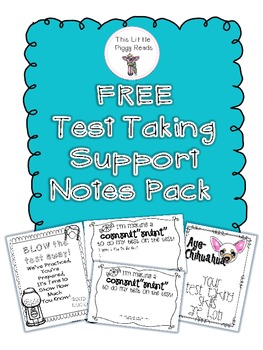
If you would like some good luck notes for your kiddos, I have some free in my TpT Store, This Little Piggy Reads.