Adding Student Choice with Guest Blogger Lauralee


Welcome to Lauralee from Language Arts Classroom, who is joining us today to tell us all about student choice when reading. Read more to find out how to add student choice when teaching literature.


I’m a reader, a lover of almost all books. Even books that I don’t love, I can normally appreciate a portion of. When I began teaching, I wanted my passion and excitement to flow to my students. And, the novice teacher that I was, I figured it would simply because of my excitement.   Of course, that didn’t happen. Some students were game, but others were clearly bored. Others didn’t read, no matter what I did. I struggled to reach all students - and I wanted literature to influence my students the way it did me.   Eventually, I found tricks that worked, lessons that reached more students. What I’ve realized is that these ‘tricks’ all revolve around giving students choice. By providing choice in literature lessons, I am reaching more students, my initial goal.   Plus, choice provides students freedom, and they are not in competition with other students. Don’t be afraid to implement student choice! To start, provide choice in small areas and move on when comfortable.   Here are quick ways to implement student choice in literature lesson plans today.   Novels   I’ve never had the freedom to choose novels with students (a YAL reading class would be a dream!), but choices with novels still exist. With older students, ask them what works best.

Choices:
  • Students can choose what review and discussion activities they like after certain sections. Present different options and students can choose their favorites. For instance, with partners students can have discussion starter prompts. Group work allows for larger analysis. Individual work can also allow choice - which graphic organizer, which writing topic?
  • Students can choose the culminating activity at the end - presentation, paper, or artwork. I’ve had some students choose a test simply because they are good test takers.
  • Are students struggling? Ask what will help them. For difficult novels, they may want guided notes.
  Short Stories/ Nonfiction   Allow students to choose stories or nonfiction pieces with structure. Explain the theme of your unit and be honest about your resources. I’ve even told students what we need to cover - literary devices, analysis processes - and that is how I developed the list of choices.   Choices:
  • Students can choose what to read. Give students a list of short stories with a short summary of each. They can vote on the short stories or nonfiction pieces that interest them as a class. For instance, I teach a spooky unit during October and typically cover Poe. I want to cover Poe. Students need to read at least one Poe, but other suspenseful stories full of conflict are out there. I allow student input for which Poe story, and then they choose others. Sometimes, they want to read multiple Poe stories!
  • My students love choosing which nonfiction piece to choose. Since most of the choices are on the Internet, I give them web addresses and ask them to choose. Then I provide a list of questions (since I have already read all potential articles).
  Vocabulary   Giving students choice in what vocabulary they study has been the easiest implementation of choice in my experience.   Choices:
  • Students can choose what words to study. This can be as simple as their choosing a certain number of words. You can also provide students with a form.
  • Students can decide how to study the words: writing a story? sentences? stand-up comedy routine?
  • Students can choose how to analyze the language. What parts of speech are the words? Can they use the verbs as participles?

  With older students, using choice improved my classroom management as well as. Students engaged in the literature because they chose their method of studying. This makes sense; appreciating literature is a personal experience.   Providing choice for students may seem like extra teacher-work. I’ve found the opposite: students see success. I’m able to meet IEP goals without obviousness. Students experience failure, and as a class we make decisions together, and feel the repercussions of them - together.   When I think back to my simplistic approaches to teaching literature, I shudder. Choice has improved my teaching and brought the joy of literature to my students - my ultimate goal.


Lauralee from

Language Arts Classroom

Using Units of Instruction in the Intervention Classroom


Hello Literacy Land Readers! Tara here, from Looney's Literacy! I've been a K-6 literacy interventionist for 11 years now! My how time flies when your having fun. Today I'm going to share some ideas and tricks I've tried over the years as I seek new ways to impact student engagement and critical thinking at each student's learning level.


Over the past five years or so my district has been working on implementing new state standards for curriculum, teacher evaluations and administrative evaluations. One of the changes we've seen includes the creation of Units of Instruction that show student growth. This took me a minute to wrap my brain around because it felt too restrictive. I couldn't imagine how I was going to adjust my instruction to meet the needs of all my learners and address all the other aspects of this type of planning.


As I dove head first into this seemingly impossible task I began to realize it can be done. Not only can it be done but it offered a whole new perspective on expectations and curriculum. As I walk you through the process I'll share some of the insights I gained and how I plan to use this method for future planning.

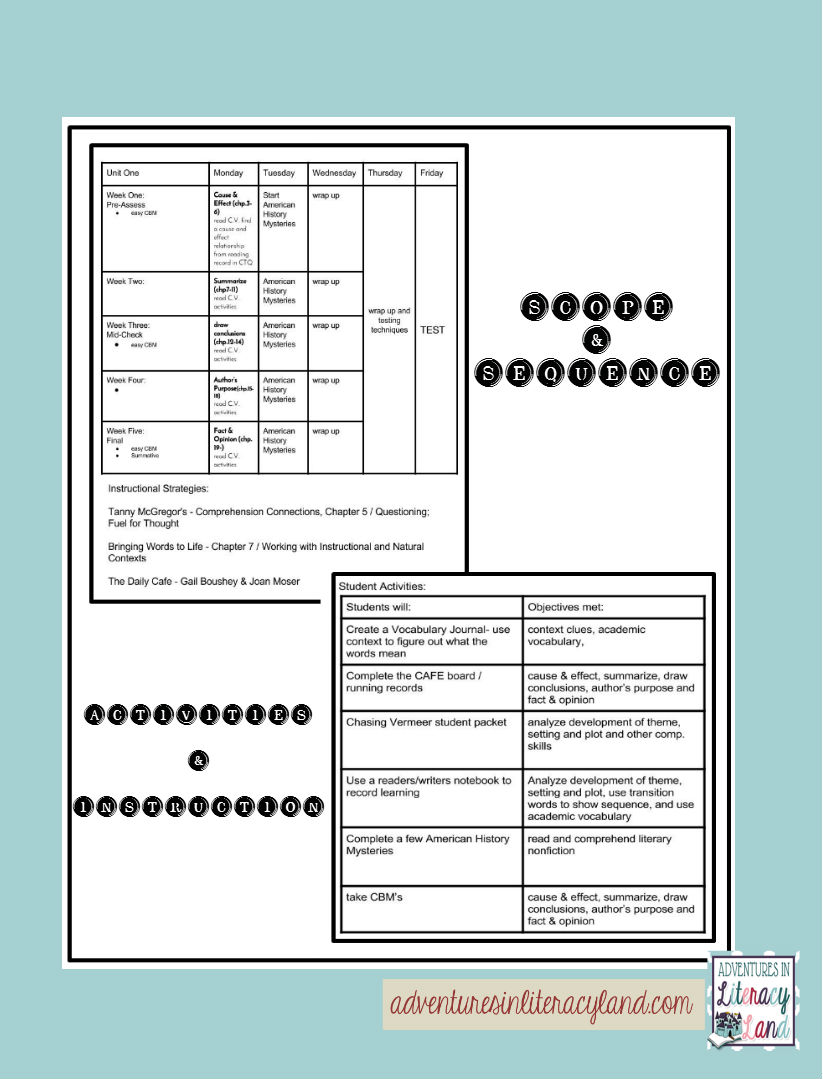
 I choose to use my sixth group group as my guinea pigs. I decided to study the  mystery genre because I found the perfect book, Chasing Vermeer by Blue Ballet. I set the time frame for 5 weeks.   Then I  determined the objectives of the unit of study by glancing at the 6th grade ELA curriculum.


At this point  I was able to outline my scope and sequence using some general info  from the
book (Chasing Vermeer) and our 6th grade ELA curriculum. Then came the fun part of employing my new found skill of asking essential question. I did a book study this past summer and used this for my professional development plan.

Then I was able to plan activities. I've learned over the years that my plans cannot be absolute and I must remain flexible as I adjust to learners' needs daily. This leaves a lot of activities undone so I rely heavily on storing things in my computer so I can print as needed. 


Resources I used:

Instructional activities
Reading journal
Close Reading Sheet

Assessment - Formative & Summative
Running Records
ReadWorks - Chasing Vermeer Assessment


There were teachers in my building who were using this amazing close reading resource from TpT that I can't seem to remember who made but when I get back to my classroom I will reference back to. I adapted the lesson page to fit this particular group and it look like this: (Feel free to download)


Opinion Writing: When Whole Group Writing Transfers to Independent Writing

Believe it or not, you can teach persuasive writing in Kindergarten. This post explains how and includes a  FREEBIE for you.

You do whole group lesson and after whole group lesson you want the students to transfer your whole group lesson to their independent journal writing.  Creating routines in kindergarten is as much about giving them tools, as it is about giving them time to practice the skill.  Our school system has adopted a new reading program and one of the writing lessons is persuasive writing. Michelle Brinn, a fantastic kindergarten teacher, was tasked with 2 things:  Introduce your students to opinion writing and do it in a 1/2 day kindergarten program.
We talked about how we could expose our youngest writers to persuasive writing and get it done in a 20 minute daily writing lesson.  Another obstacle in Michelle's lesson would be time.  She decided it would be a modeled writing, just to manage time.  We mapped a plan:
Believe it or not, you can teach persuasive writing in Kindergarten. This post explains how and includes a FREEBIE for you.

Monday

Decide what two items the students will compare.  The topic needs to be something that is easily understood...not every child will have opinions on soccer v baseball (of course, soccer is better) or whether summer or winter is the best season (of course, summer is better).  BUT they will probably have an opinion about whether dogs or cats are the better pet.

Tuesday

Talk about Option 1:  dogs.  What are 3 reasons dogs are great.  The students were eager to tell why their liked dogs, but we stuck with 3 ideas.  She asked them to keep all their other ideas for later in the post.

Believe it or not, you can teach persuasive writing in Kindergarten. This post explains how and includes a FREEBIE for you.

Wednesday

Talk about Option 2:  cats.  What are 3 reasons cats are better.  Once again, students were eager to share their ideas.  Students liked how cats were quiet.  

Thursday

The vote!  Students were asked to vote for their favorite pet.  They chose dogs (of course, they did).  Michelle asked for more reasons why dogs were the best choice.  Their ideas were fantastic.  

Believe it or not, you can teach persuasive writing in Kindergarten. This post explains how and includes a FREEBIE for you.

Friday

The wrap up!  Students were finally asked to write a closing sentence.  Michelle asked for MORE reasons dogs were chosen and the students came through with great ideas.

It was a success.

As a whole group writing lesson for the week, it was definitely a success.  The students were excited about pleading their case for why dogs were better than cats OR why cats were better than dogs.  BUT the really exciting part was getting ready to happen...

Independent Journal Time

With all the chatter and opinions about cats and dogs going on in her classroom, Michelle asked the students to write about it in their journals.  We were THRILLED with the results and I think you will be, too.
Believe it or not, you can teach persuasive writing in Kindergarten. This post explains how and includes a FREEBIE for you.

I have said it before, and I'll say it again:  Too often we give students excuses, instead of tools.  Michelle did a fantastic job of giving her students a tool for persuasive writing.  She gave them an easy plan...and time to practice. 

If you'd like a SAMPLE Opinion Writing, click the image below.


Math and Literacy Connection: Poetry

According to LaBonty and Danielson (2004), "reading and writing poetry about math involves students with listening, speaking, reading, and writing in order to develop and demonstrate an understanding of mathematical concepts and relationships."
Using poetry in math can develop an understanding of mathematical concepts and relationships. Visit this post on Adventures in Literacy Land to learn more.

Patterns are important in math as well as in poetry and both are dependent on students' skill with language (symbols/signs and verse/rhyme).  Poetry is an alternative vehicle for students to fine-tune their skills with the language of mathematics.  Reading and listening to poetry about math allows children to be immersed in the language of math.  Collaboratively writing poetry helps children function as "problem solvers rather than information receivers" (LaBonty and Danielson, 2004).

What does this look like in the classroom?

  • Lakeshore Learning provides a "read and respond" version of "Arithmetic" by Carl Sandburg
    • This would be a great beginning of the year activity to get students thinking about how they use math every day.
  • Using Shel Silverstein poems in math lessons from We Are Teachers
    •  "One Inch Tall" could be used to introduce the concept of an inch and what that measurement looks like in real life.  Then students can use the poem as a mentor text to write their poem using a different measurement (one centimeter, one meter, etc.).
    • Using the poem "Smart," you could see if students understand the difference between number of coins and the value of coins.
  • Illuminations lesson using "Shapes" by Shel Silverstein
    • Great to use in kindergarten after learning about all the shapes - read the poem out loud to the students and have them draw a illustration that depicts what is happening in the poem. Then students can discuss with each other what words/phrases in the poem helped them decide what to draw.
  • For any topic that you are teaching in math, students can write a poem that shows their understanding of the concept being learned.  I suggest only doing this after you have given students multiple examples of poetry (math and non-math related).
    • Each student can write a poem and they can be collected into one class book with a title that encompasses all the poems (for example:  Multiplication in Mrs. Wilson's Room or Quadrilaterals in My Life)
  • Looking for students to use mathematical terms but in a different way, you need to read this article about a collaboration between a high school math and English teacher - loved it! 
  • A second and third grade teacher used The Important Book as a mentor text to have students write about a geometry term.  This article "Mathematics and Poetry" details what she did.
If you missed previous posts in the Math and Literacy Connection Series, no fear, I have linked them for you:
  • January - introduction on why the connection is important and learn about the vocabulary strategy: word splash
  • February - teaching academic vocabulary in math using strategies from your literacy instruction
Next month I will continue the series with writing strategies that help students in math.

Math and Literacy Connection Series at Adventures in Literacy Land

 photo thinkingoutloudtitle.png