Making writing stick!

Writing in Kindergarten can be such a daunting task at times.  So many kids have never been exposed to writing before.  Sometimes they don't even know how to hold a pencil!

In order to teach Kinders how to write a complete sentence, they also need to understand what a complete sentence is.  So often, students at this age speak in single words or phrases.  In my writing center, I combine these two skills and embed my sight word lessons into it at the same time!

While planning the order in which I teach sight words, I always try to make sure that we can use them to build sentences.  For example, the first sight words that I teach are "I" and "see."  This way we can use our new sight words to write a sentence, "I see ___."

Here is my list of the sight words that I use and the sentences that we create with them!


So on Monday, I introduce our new sight words.  We even practice reading a few sentences with these sight words in them.

On Wednesday, we do a shared writing. I give each student a word card to help them with building our sentences.  I have several word cards with different themes that are stuck in a folder with Velcro.  This way students can manipulate them when we get to center time.  Once each student gets a card, I have them take turns using the word in a complete sentence using our new sight words.  I write them down as they tell me.  We discuss spacing, capital letters, periods, etc, all while writing the sentences.  Once every student has a had a turn, we practice reading everything that we have written.


On Friday, each student writes their own sentence using our sight words and a word card that they have chosen.  They illustrate their picture and then we put them together into a class book.  Our book goes in our library so that our kids can read their own writing during library time!

The following week, during writing center, our students will practice building their sentences with word cards, writing them, and illustrating them!  They have gotten so good at sight words and writing with this center!


How to Use Top 20 Book Lists to Motivate and Excite Readers

What do you think qualifies a book for a 
"Top 20" list? 

Trendy Topic?
Eye catching cover?
Vivid Vocabulary?
A Plot like No Other?
Amazing facts?

Probably all of the above.

For today's post, we're going to explore those Top 20 lists a bit, see whether they are must haves, and how they can add to the learning in your classroom.
Do you frequently check out the Top 20 book lists at your favorite stores? How about using them in the classroom? Check out this post on Adventure in Literacy Land for ways you can motivate your readers with Top 20 lists.
Have you wondered where you find Top 20 Lists and who makes them? Does that make a difference? You betcha! After all, if the reader is a child, it might be wise to get a child's point of view I'd think. If you think about Trip Advisor or other sites that do rankings, they typically have some criteria for their decisions and expertise in the field. Some top 20 lists may be done by sales while others may be judged by librarians or site managers.  Regardless of how the lists are formed, they do highlight new titles for us. They are great ways to learn about what's new in children's literature and if you purchase them, it gives you a chance to do a little "market research" for yourself to see if they really measure up. Not willing to let loose of the cash? Maybe pull them from the library first to see for yourself.

Do you frequently check out the Top 20 book lists at your favorite stores? How about using them in the classroom? Check out this post on Adventure in Literacy Land for ways you can motivate your readers with Top 20 lists.
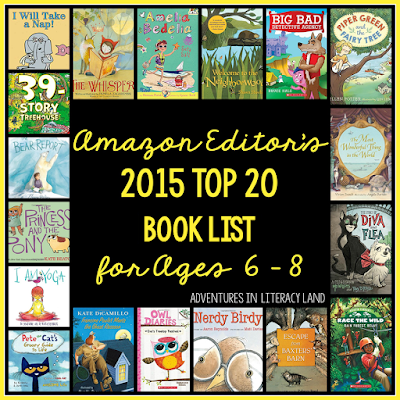
Before I move on with this post, I feel like I should share that the idea for this post came when I visited Amazon this last weekend. I discovered the Top 20 lists in the children's book section on the site. Well, I am a book hound, so I had to check the lists out. You know there might be a title that I DON'T have (gasp!), so I went to take a peak, and here's what I found. This is the book list for ages 6-8. At first, I thought it was a list from the New York Times, but then I found it was the Amazon Editor's list. It does not say what the selection criteria was, so I'm not sure if it's based on sales, choices the editors liked, or if there was an evaluation process. Even though I'm not sure how the books were selected, I did notice common themes..animals, adventure, and make-believe. I also noticed a few favorite authors and book series including Pete the Cat, Amelia Bedelia,and Francine Poulet. Mo Willems also made the list, but there are also lots of unique looking books too. I am very curious about Nerdy Birdy, The Whisperer, and Escape from Baxter's Barn. Out of this 20 book list, only five or six were familiar to me, and I love that because now I have new options to look for in the coming months.

So, how can the enthusiasm we get when we see or hear about new titles translate into classroom enthusiasm?  Ultimately, that is the reason for the book lists. The goal is to build excitement about the books and more importantly, getting the books into the hands of kids.

TOP 20 IDEAS FOR THE CLASSROOM
Looking through Amazon's Top 20 list got my teaching wheels going. I had flashbacks to Lettermen's Top 10 Lists. Remember those??  We found them interesting and funny. I hope as you scan through these ideas, your teaching wheels get going too.

Create Room __'s  Top 20 Best Books for 2015
Take your class into the library for a Top 20 analysis session. Prior to the visit, develop a selection criteria with the group. You might set a page range, publishing year (of course), characteristics the students agree upon, and time limit prior to going, and once in the library, you'd want to have forms available for the students complete in order to keep them accountable. You might pair your students to allow for deeper discussion and comparison. You could have each pair of students come up with two books they'd put on the list which would ideally end up being around 20 books total. You could gather up the books and allow the students to "visit them" throughout the following week and then rank them in the order they feel is best.
Develop Top 20 Book Lists by Genre
After you've developed overall winner lists as a group, you might move on to genre lists. Kids have reading preferences, so tapping into those can lead to better book selection later on. In fact, I'd divide into groups based on the books that the kids prefer. Again, you'd want to establish the selection criteria and how the researching will be done. (Do you allow kids to search the internet? In the library? or do it by polls?) Once the time limit is up, then it's time to narrow by analyzing those in the first "selection round". You might even compare this experience to the NBA draft. :-) Secretly though, you're developing a reader's eye for book selection and providing kids with a mental list of what they want to read next.
Real Readers Need Personal Lists
After experiencing these first two options, you can then focus on reader plans. Real readers need ongoing lists of what to read next. If you remember, we've had a few posts about Donalyn Miller's 50 Book Challenge, and I think Top 20 Lists feed right into it. Your kids can keep and revise their Top 20 list all year long. Imagine how fun it'd be to compare the list at the beginning of the year and at the end of the year. My guess is that it will change as the year goes, don't you think?

I read recently as I was researching and thinking about a blog post I wrote about deep thinking that classifying and categorizing information is one great way to work on deep thinking. Throughout the list making process, your kids will be using the following skills:
    Do you frequently check out the Top 20 book lists at your favorite stores? How about using them in the classroom? Check out this post on Adventure in Literacy Land for ways you can motivate your readers with Top 20 lists.
  • comparing across texts specific features you've agreed upon.
  • analyzing the text features of the books including plot and character development, vocabulary usage, and creativity.
  • observing through the writer's eye which may lead to improved writing skill.
  • learning about new titles and authors
  • using library tools to look for their books
What skills would you add to this list?  How would you change up the idea or use Top 20 lists?  (please share in the comments). 

To get you started, I created a quick freebie to share with you using some of the ideas shared above. I hope it works well for you and that you see lots of excitement from your students after you give it a try, and better yet, I hope it gets them headed to the library with new book list ideas.


Non-Fiction Text Structures with Gail Gibbons

Learning and understanding the five text structures for non-fiction can be hard for 8 and 9 year old students.  In fact, it can be hard on a teacher to teach the five text structures to 8 and 9 year old students.  But luckily, Gail Gibbons has made it a little easier on all of us!
Non-fiction texts are not my students first choice of genre to read.  Plus, informational text is a huge part of the state reading assessment in Ohio.  Exposing my students to all kinds of non-fiction is crucial when it comes to third grade.  So, I know that I need to spend quite a bit of time each year discussing "structure" and how it can help students understand the way in which an author builds a text.  Text structure refers to the way  an author organizes information in a text.  Teaching our students to recognize the structure of content-area texts, can help students focus attention on concepts, relationships, and help them monitor their comprehension as they read.

Using Reader's Theater to Build Fluency

Many of my early readers read word by word, with little expression. I need to provide experiences for them to read more fluently and with proper phrasing and intonation. This will not only make their reading sound better, it will make the content more comprehensible. 

Read-alouds and shared readings allow teachers to model how fluent reading sounds and shapes the understanding of the text. 

Rereading stories helps students practice reading books on their independent reading level to improve their fluency and comprehension. 

During guided reading groups teachers can build fluency and support children’s expressive reading through choral reading, reading along with books on tape and reader’s theater.
Provide opportunities for your Kindergarten students to read fluently and with expression by using reader’s theater scripts in Kindergarten. This post includes a link to a great professional read and pictures of reader’s theater in action in a Kindergarten classroom.
I love developing my students’ fluency skills using all of these strategies, but my favorite way to work on fluency and reading expression is reader’s theater. I first fell in love with reader’s theater when I read Sharon Taberski’s book Comprehension From the Ground Up and had the opportunity to meet her.  Since there were not many Reader’s Theaters for Kindergarten she encouraged me to write my own.
Provide opportunities for your Kindergarten students to read fluently and with expression by using reader’s theater scripts in Kindergarten. This post includes a link to a great professional read and pictures of reader’s theater in action in a Kindergarten classroom.
Reader’s theater helps readers develop fluency, build detailed retells and improves phrasing and expression when reading. Reading, speaking and listening are combined to make reading an engaging experience for my students. My students LOVE performing reader’s theaters and look forward to Theater Thursday when we break out the microphone for our weekly performance. Check out Comprehension From the Ground Up and consider adding reader's theater to your reading workshop.
 
Are You My Mother? from Jonelle Bell on Vimeo.
Provide opportunities for your Kindergarten students to read fluently and with expression by using reader’s theater scripts in Kindergarten. This post includes a link to a great professional read and pictures of reader’s theater in action in a Kindergarten classroom.
Check out more about Reader's Theater on my blog, 
A Place Called Kindergarten.