Comparing and Contrasting Animals

Happy Spring everyone! It's Jen from An Adventure in Literacy here to share an easy activity for comparing and contrasting. I had been working on comparing and contrasting all week with my first graders and wanted to add a little playful fun to the subject...so I pulled out plastic eggs and animals.


To start off the fun I read Big Egg by Molly Coxe. I double puffy heart love this book! It is a quick read with simple text and bold illustrations. I've used it in many grade levels for predicting and making inferences from pictures. For this activity it served as a quick hook to introduce the project. The story in an eggshell is that Hen finds a big egg and tries to figure out what kind of animal egg it is. 


I used eight plastic eggs each filled with a different small plastic animal. I let the students know that just like in the book, all of the animals in the eggs are not necessarily animals that would really hatch from eggs. Each table got to choose two eggs from the basket.


As a table group they worked together to compare and contrast their two "hatched" animals using an egg shaped Venn diagram. Each group also presented their animal comparisons to the class. The next step in the project could be to write paragraphs that highlight the similarities and differences in the animals. A basket of eggs and the Venn diagram could also be a very engaging center!


I'm sure every elementary teacher has extra plastic eggs and animals lying around, so grab the Venn diagram freebie here to have your own egg animal fun! What other fun activities do you use to teach compare and contrast? Let us know with a comment!


Tools For Ear Readers


Hi everyone! Emily, from The Literacy Nest (formerly The Reading Tutor/OG) here. I'd like to talk about a phrase called ear reading today. Have you heard of it? Ben Foss, The author of The Dyslexia Empowerment Plan coined the phrase. Ear reading versus just eye reading has many benefits for your struggling readers. Read a quick excerpt from Ben:
The Dyslexia Empowerment Plan: A Blue Print to Renew Your Child's Confidence and Love of Learning:
A child with dyslexia will never eye-read as well as his peers, and that, I hope to reassure you, is fine. Yet all children need to be exposed to vocabulary and ideas to be successful in school. If your child was blind, providing text as audiobooks or Braille would allow her to read with her ears or with her fingers. No one would ever claim that a blind person was lazy or stupid for not reading text with her eyes. When I listen to audio, that’s ear reading. When I speed it up to four hundred words a minute, four times the pace of standard speech... I am leveling the playing field for me.* It’s not what the mainstream conceives of as reading. But it’s ear reading. It’s learning. It’s literacy.
(Link to Headstrong Nation)

What is ear reading?
Ear reading is simply having access to audio while reading a text. When a slower reader in your class is reading, having the additional audio and any other speech to text technology is a great way to accommodate them. For some people, it may be the only way they will be able to access (read and comprehend) text successfully. That's a pretty powerful statement. You can make this happen for them in your classrooms.

Who benefits?
Think of a child in your class who struggles to learn to read. You may have just asked them to retell events of a story of write a summary. Adding a writing task on top of remembering details they read only while 'eye reading' becomes monumental. Think of adding audio as a way to level the playing field for those children. They'll be able to listen successfully and then be able to complete that oral or written task. When you use audio, you can also train yourself to listen more rapidly by speeding up the text you to. You've heard of people taking speed reading courses, haven't you? Well, why not try speed listening? This may help older students learning to read. Watch a demonstration of it here. DEMO


How do I find audio books?
Since 1 in 5 students in your class are dyslexic, it is imperative to have audio text. If you have grant money or planning your school year budget, investing in audio books, a good listening center,            e readers, and headphones are worth every penny.
  • First, look into two sites: Learning Ally and Bookshare. Call to see if your state has funding money to provide one of these audio book sites in your classroom. Many have, but sometimes schools don't know about it. 
  • Many reading anthology series and text books come with audio CDs and access to read them online. As long as your district has purchased them you should be able to have them in your classroom. 
  • No listening center? Buy a pair of headphones and set a child up at a computer to read. If you have mobile tablets in your classroom, even better. I want to caution you that the voice on some e readers sounds robotic. Your child may not like having to hear a robot voice read to them. (Would you?) Always check if it's an adult with a pleasurable reading voice. 
  • Next, check some of the free sites online. Here is a pin from one of my Pinterest boards to access over 600 free audio books. 
  • Use your local library for books CD.
Have you tried using audio books with your students? How has it helped them? Please share in the  comments. Thank you for stopping by Literacy Land today!


4 Vocabulary Ideas to Avoid Reading Roadblocks

4 Vocabulary Ideas to Avoid Reading Roadblocks (Anchor Charts, Text Gradients, Diagrams, Act it out!)

I had the distinct privilege of presenting just recently at the Virginia State Reading Association Conference in Richmond.  One of the workshops was on Vocabulary.  I blogged briefly about this presentation in my latest blog post on my website, but thought I would give you a more in depth look at vocabulary here today.

Anchor Charts/Prediction Posters

4 Vocabulary Ideas to Avoid Reading Roadblocks (Anchor Charts, Text Gradients, Diagrams, Act it out!)
I am a big fan of Anchor Charts.  Done the right way, anchor charts are invaluable to your students. Anchor charts can be pre-made but must also allow for editing, if an unsuspected word misunderstanding occurs.  Pre-assessing a book for vocabulary roadblocks is a must.  Pulling out words you believe will create "comprehension potholes" or "run the story off the road" are a must for a successful Read Aloud. Before reading a book, introduce words to your students out of context.  Talk about the meaning.  Demonstrate the meaning.  Discuss how this particular word might be in this book.  You may even want to read the sentence from the story.  Preparing for vocabulary can help students spend time on higher order thinking than on the meaning of a single word.  One type of anchor chart is the Story Map.  Words from the story, both common and new, can be written on post-it notes given to the students before they read the book.  Students will predict if the words belong on the map in provided spaces:  Characters, Setting, Actions (verbs), Things (nouns) and New to You.  If they encounter a word while reading that needs to be moved on the chart...they can easily be moved.  

Text Gradients

4 Vocabulary Ideas to Avoid Reading Roadblocks (Anchor Charts, Text Gradients, Diagrams, Act it out!)
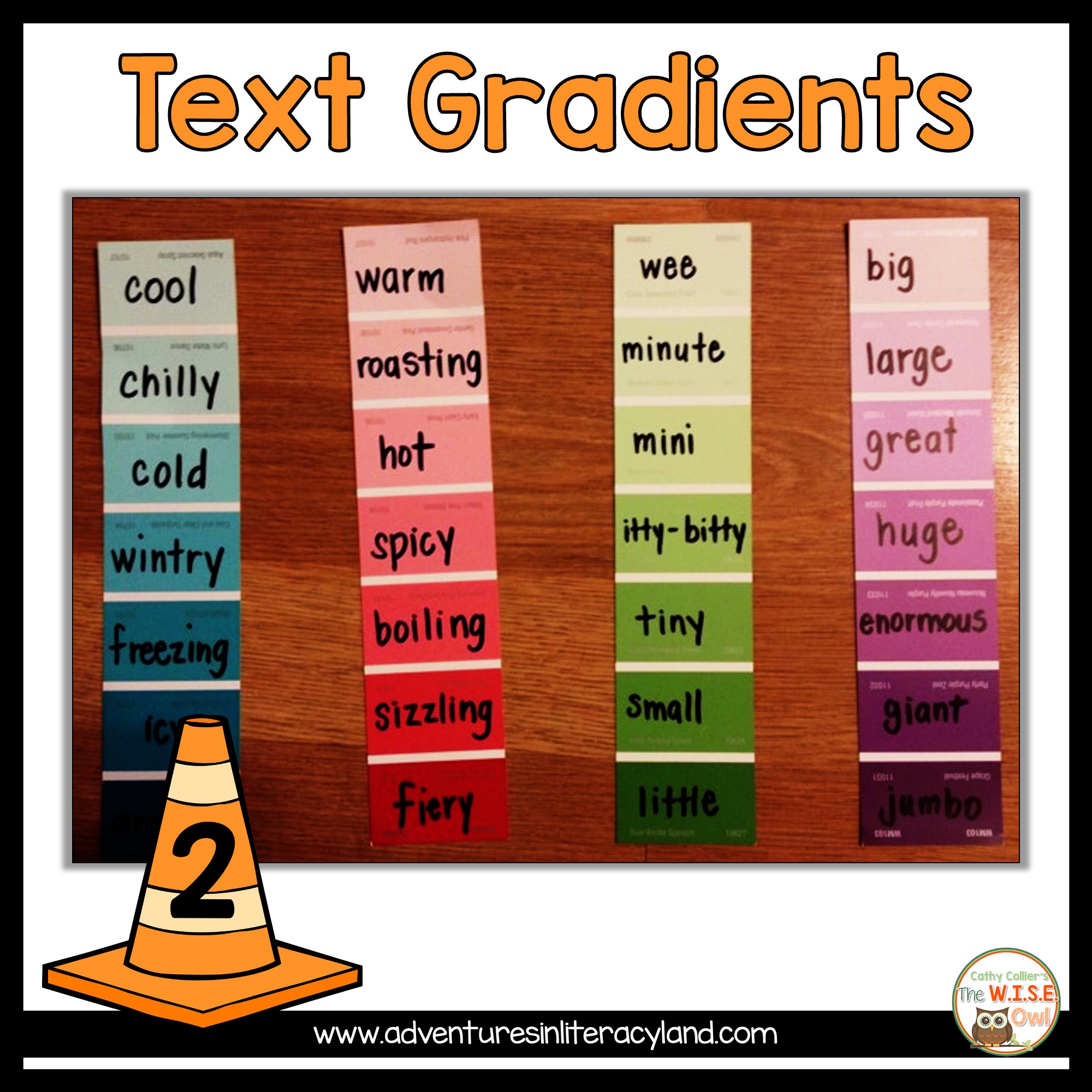
I actually LOVE text gradients.  Typically, text gradients are used in the upper elementary but every kindergarten teacher has tried to get her student's to use words more descriptive than small or big.  The famous "said is dead" refrain is heard in every first grade class.  So, let's talk primary text gradients.  A wonderful way "add color" to writing is using paint strips.  (I live in fear of paint strips eventually costing money.)  The paint strips can be put in library pockets in the writing center and students can take a color strip to make their elephant "enormous" or their ladybug "tiny."  

Diagrams

4 Vocabulary Ideas to Avoid Reading Roadblocks (Anchor Charts, Text Gradients, Diagrams, Act it out!)
Providing students with diagrams is a great way to introduce vocabulary that is both familiar and unknown.  When studying about bats, my students were excited to learn bats had thumbs.  They look very different from our thumbs, but they are still thumbs.  They were also intrigued by the membranes in their wings.  We compared the membranes to duck's feet.  We even found out turtles, otters and some reptiles have webbed feet.  Diagrams draw the student in and help them write about animals and make comparisons.

Act it Out!

4 Vocabulary Ideas to Avoid Reading Roadblocks (Anchor Charts, Text Gradients, Diagrams, Act it out!)
When we were preparing to read The Knight Before Dawn, I introduced some words to the students before we read.  One of the words was "precipice."  I needed to relate Jack dangling from a precipice on the castle tower to the students in my class.  First, I showed them pictures of large cliffs in the desert or on mountains. Then, we went to the playground.  The only cliff they really knew about was the playground equipment.  One at a time, the students went to the edge of the playground equipment and they yelled, "I AM ON THE PRECIPICE!"  Then they were allowed to jump off the "cliff."  Trust me they all knew what a precipice was and when Jack was hanging from the precipice they could anticipate his falling!  That's the power of vocabulary!

These are just a few ways you can make sure to introduce children to wonderful vocabulary words they can use to write, make connections, and understand.


Exploring Creatures: Using Informational Texts and Expository Writing in Language Based Intervention


Tara here from Looney's Literacy to share using expository texts and writing  to create a language based literacy intervention. 


Oral language is a driving component of future literacy success. Language based intervention is critical in  kindergarten and 1st grade. 

With strong oral language skill comes more vocabulary knowledge. With strong vocabulary skill comes more understanding of "book language" and stronger comprehension skills.  What better way to practice language then researching interesting creatures and writing an expository text, right?


So we did! 

 My kindergarten students are studying different creatures in their classroom.  In my class, we recently read some non-fiction texts about animals. So I took this teaching opportunity and turned it into a fun language based activity!  

After reading our non- fiction texts on animals that can go fast, we used the smart board to research the animals they were most interested in.  

They had so much fun chatting about the things we found about sharks and hummingbirds they forgot they were learning! I've collected some great resources about these two amazing  creatures and would love to share!

HTML tutorial HTML tutorial HTML tutorial
HTML tutorial HTML tutorial HTML tutorial HTML tutorial


 We used expository texts  as an example to begin our writing. Our next step was to organize our information.


 Then we choose 3 topics about our animal and used them to complete our Table of Contents.


Our next step was to write our chapters! 

This was a great opportunity to study non-fiction text features, write expository texts, and use academic vocabulary to build upon our prior oral language language skills. And we had a blast in the process!